Why Cynicism Fails in the Face of Courage, and What We Learn When We Refuse to Look Away
The Noise, The Cynicism, and The Veteran’s Filter
It started, as so many things do in our fragmented media landscape, with a familiar kind of algorithmic noise. I had come across the announcement of a Tucker Carlson interview featuring Volodymyr Zelenskyy’s former press secretary, Iuliia Mendel.
The framing was predictable: an insider coming forward to air personal grievances, paint the Ukrainian administration as authoritarian, and feed the growing Western narrative that continuing to arm Kyiv is a mistake — that Ukrainian resistance, rather than Russian aggression, is the true obstacle to peace.
I did not want to swallow that framing whole, but I also refused to operate on blind faith. I went to my AI collaborator, Gemini, with a straightforward intent: vet this former press secretary, explain why she left the administration, and help me untangle what was legitimate reporting from what was opportunistic political theater.
Carlson has always been a complicated figure to parse. When he was on Fox News, I could hardly stand him. Yet in his post-cable life, after openly expressing regret for aspects of his past and showing flashes of candor, he has occasionally engaged in substantive discussions on religion, culture, and foreign policy that conventional television avoids.
We share a deep distaste for the political opportunism and the cynical machinery of modern governance. But when it comes to Ukraine, the trajectory of his platform is unmistakable: an unyielding skepticism toward Western support that eagerly platforms voices serving a specific, isolationist thesis.
I realized I didn’t need to sit through another round of televised grievance-mongering. Just the day before, I had watched Steven Bartlett’s long-form interview with Zelenskyy on The Diary of a CEO. That conversation was the polar opposite of cable news soundbites.
It was stripped of rhetorical theatrics — a leader speaking plainly about the sheer human weight of wartime governance, standing in the devastation of Bucha, and the visceral emotional toll on parents and soldiers.
Does Zelenskyy do everything correctly? No. No wartime leader in history ever has. But listening to him speak with that level of unvarnished vulnerability made the talking points floating around Washington and Moscow feel entirely hollow.
When you look at modern political discourse, you quickly notice that war is treated like an abstract parlor game.
Pundits and contrarians debate front lines and military aid between bites of cake and sips of Coca-Cola, safe in the comfort of their living rooms. For them, an invasion is content; every act of defiance must be a “PR stunt,” and every sacrifice must hide a cynical financial motive.
I don’t have the luxury of that detachment. My filter was forged elsewhere.
I served five tours with the United Nations Interim Force in Lebanon (UNIFIL) in the security zone of South Lebanon. I carried a weapon, wore the blue beret, and lived with the constant, grinding friction of an active conflict zone.
I stood in front of Israeli military bulldozers when they pushed into the Norwegian contingent’s area of operations (NORBAT), refusing to yield ground because our mandate required us to hold the line. And in April 1996, I was a direct witness, among the first to enter the Fijian Battalion HQ just after the shelling. It was an attack that became known as the Qana massacre, where high-explosive artillery shells ripped through a UN compound sheltering hundreds of civilians.
When you have smelled burning gunpowder and flesh, seen what jagged shrapnel does to human body, and watched terrified families scramble for cover, war ceases to be an academic exercise. It stops being a debate about geopolitical theory.
You understand immediately that when artillery strikes an apartment block, it is not an intellectual talking point — it is murder.
That lived experience creates an unavoidable chasm between myself and people I once considered friends. I have watched acquaintances slide effortlessly down the rabbit hole of Kremlin talking points, adopting the lazy, contrarian posture that Ukraine isn’t worth defending, or that resisting an unprovoked invasion is somehow warmongering.
I cannot sit in a room with that mindset. It isn’t a petty disagreement over municipal taxes or public spending; it is an irreconcilable divide over fundamental human ethics. When someone living in safety and freedom casually excuses the slaughter and subjugation of a sovereign people, they are revealing their core moral compass.
Cutting those ties and clearing my feeds isn’t an emotional overreaction—it is setting a boundary of basic human decency.
As I laid all this out to my collaborator, our objective became crystal clear. We were not going to construct a sanitized fairy tale or paint Zelenskyy as a flawless hero.
Sovereignty and the right to exist do not require a leader or a nation to be spotless. To truly understand the courage displayed in Kyiv, we had to start by looking directly at the flaws, the failures, and the genuine mistakes made by the Ukrainian administration — without flinching, and without excuses.
The Unvarnished Ledger: Facing the Flaws of Bankova
When you set out to examine wartime leadership honestly, you have to be willing to look directly into the blind spots. In our conversation, I didn’t want Gemini to offer me comforting excuses or gloss over the dark corners. I wanted the cold facts.
If you want to defend a nation’s right to sovereignty, you cannot build your case on a sanitized myth.
And the truth is, the administration inside Bankova Street had accumulated a substantial, documented ledger of misjudgments, institutional tug-of-wars, and flawed decisions long before and during this war.
The first, and perhaps most painful, wound in modern Ukrainian memory goes back to the months immediately preceding February 24, 2022.
As American and British intelligence agencies issued unprecedented, declassified warnings that Russian divisions were staging for a full-scale assault, the public messaging from Bankova was notoriously dismissive.
We all remember the infamous reassurances urging citizens not to panic and promising that Ukrainians would be enjoying “barbecues in May.” When I listened to Zelenskyy in The Diary of a CEO, he maintained that he genuinely did not believe a full-scale invasion of that barbaric magnitude would actually occur.
I don’t doubt his personal sincerity in that interview; he was facing a catastrophic dilemma. If he had sounded the alarm months earlier, the Ukrainian economy could have collapsed overnight, foreign capital would have fled, and a systemic bank run might have paralyzed the nation before a single Russian tank crossed the border.
But the physical price of that calculation was devastatingly steep.
Northern defense axes were caught scrambling, civil defense stockpiles were organized at the eleventh hour, and the southern defensive corridors fell with catastrophic speed, leading to the rapid occupation of Kherson. Ukrainian veterans, regional leaders, and investigative reporters have not forgotten that unpreparedness, and rightly so.
Then there is the structural architecture of Bankova itself: the problem of hyper-centralization.
Zelenskyy entered office in 2019 as a political outsider, sweeping away the old guard on a wave of popular anti-establishment fury. But when an outsider takes the helm of a massive, Byzantine state apparatus, the instinct is almost universal: you circle the wagons. You surround yourself with the people you know and trust.
In Zelenskyy’s case, that meant elevating long-time associates, legal advisors, and production colleagues from his Kvartal 95 days.
This created a shadow presidency within the Office of the President. Power became heavily concentrated in the hands of an unelected inner circle, dominated by Chief of Staff Andriy Yermak.
Western diplomats, Ukrainian parliamentary opposition, and civil society groups frequently voiced alarm over this dynamic. Decisions that constitutionally belonged to formal cabinet ministries or the Verkhovna Rada were increasingly drafted, approved, and executed from a tight, insular bubble where loyalty was prized and outside dissent struggled to penetrate.
Yet to look at Kyiv in isolation is to ignore a broader, systemic disease creeping through many modern democracies. This insular concentration of authority is not a uniquely Ukrainian pathology; it is an increasingly dominant Western export. From the Oval Office to the Élysée Palace, we watch a tightly knit managerial elite quietly override traditional institutional checks.
In Washington and Paris, the democratic machinery is steadily hollowed out by unelected strategists, tech-adjacent advisors, and closed-door coalitions who draft epoch-defining policies far removed from the public or parliamentary oversight designed to govern them. The bubble on Bankova Street is simply a wartime caricature of a corporate, technocratic instinct that is taking root across the globe, stripping elected bodies of their true legislative purpose.
This insularity inevitably sparked sharp clashes with Ukraine’s independent anti-corruption bodies.
Ukraine has spent years building aggressive, Western-backed investigative institutions — specifically the National Anti-Corruption Bureau (NABU) and the Specialized Anti-Corruption Prosecutor’s Office (SAPO).
Yet whenever investigations began inching uncomfortably close to figures within the presidential apparatus or defense procurement chains, Bankova pushed back. There were calculated efforts to delay reform appointments, regulatory hurdles placed in front of independent prosecutors, and legislative maneuvers to shield political allies.
When I brought this up in our discussion, I originally thought Zelenskyy had simply “walked back” on these mistakes out of good judgment. Gemini gently pulled me up on that. “Walked back” made it sound far too clean, as if the administration just woke up one morning and had a change of heart.
The reality was a ferocious, public tug-of-war. Bankova retreated only because independent Ukrainian journalists published ruthless exposés, civil society groups organized vocal resistance, and Western allies drew hard, non-negotiable red lines, making financial and military aid explicitly contingent on institutional autonomy. The watchdogs survived, but they had to fight tooth and nail for every inch of their independence.
That same friction bled into the military sphere.
When Zelenskyy eventually replaced General Valerii Zaluzhnyi as Commander-in-Chief, it laid bare a deep strategic divergence. Zaluzhnyi was a military realist who spoke candidly about battlefield stalemates, the brutal mathematics of attrition, and the urgent necessity of large-scale, systemic mobilization.
Bankova, hyper-conscious that Western military aid depended heavily on the perception of momentum and victory, pushed back against talk of stalemate.
The administration grew visibly uneasy with the soaring, apolitical popularity of front-line commanders, leading to changes that critics argued were motivated as much by managing political optics as by operational strategy.
Under martial law, domestic politics and civil liberties suffered their own strains.
The establishment of the Yedyni Novyny (United News) telethon was an understandable emergency measure in the opening hours of the invasion to prevent panic and counter Russian psychological warfare. But as months turned into years, that centralized broadcast became an echo chamber — criticized by domestic watchdogs and European monitors for sidelining opposition parties, ducking hard investigative reporting, and presenting a curated reality.
Meanwhile, municipal leaders, like Kyiv Mayor Vitali Klitschko, openly accused the central government of using military-civil administrations to sideline elected local councils and centralize political control.
And then there was the agonizing delay over mobilization. For months throughout 2023 and 2024, front-line infantry units suffered from severe physical and psychological exhaustion.
Yet the administration hesitated to enact politically painful mobilization reforms or lower the draft age. As a former soldier, I understand both sides of that brutal coin. Any leader with a soul dreads drafting younger generations in an aging society with a demographic crisis.
But the prolonged hesitation left veteran units without rotations and allowed chaotic, heavy-handed enforcement tactics by local draft offices to erode public morale before necessary legislative reforms were finally passed.
Looking at this entire ledger, a crucial truth emerges that foreign cynics deliberately miss: Ukraine is an evolving, maturing democracy, not an autocratic monolith.
When Ukraine broke away from the Soviet Union in 1991, it didn’t magically inherit a polished Western European civil service.
It inherited decades of Soviet administrative rot, systemic institutional corruption, and security apparatuses thoroughly penetrated by Moscow. You do not overturn a century of institutional gravity simply by raising a national flag. Transforming a society out of that shadow takes generations of bloody, stubborn effort.
The defining difference between Kyiv and Moscow is not that Ukrainian politicians are immune to ego, paranoia, or power grabs. It is that Ukrainian civil society fights back, and the state is forced to listen.
In Vladimir Putin’s Russia, when the executive centralizes power, critics are poisoned, thrown out of windows, or sent to die in Arctic penal colonies. There are no watchdogs; there is only silence and subjugation.
In my room, you do not get to look away from this fact, and claim that Zelenskyy is a failed leader, and that Ukraine is a Nazi state that is to blame for the Russian invasion.
In Volodymyr Zelenskyy’s Ukraine, when the presidential office overreaches, investigative reporters expose it on the front pages, watchdog agencies sound the alarm, parliament pushes back, and the administration is forced to course-correct.
That process is messy, noisy, and deeply imperfect. But that friction is the sound of a democracy staying alive under the crushing weight of total war.
The Global Fracture: The Horseshoe of Apathy vs. The Courage to Stand
Once you clear away the immediate fog of the battlefield and look at how the rest of the world responded, the conventional political compass falls apart.
Growing up in Western Europe, we were taught that politics is an orderly left-to-right axis. The left cares about international solidarity, human rights, and social justice; the right cares about national sovereignty, defense, and the rule of law.
But when Vladimir Putin unleashed full-scale war upon Ukraine, that neat spectrum bent until its ends touched.
It confirmed what political theorists call the Horseshoe Theory: when you push far enough toward the fringes, the radical left and the radical right stop being opposites.
They end up standing on the exact same patch of dirt, arriving at the exact same functional outcome — abandoning a democracy to be crushed by a tyrant.
On the populist hard-right, the sympathy for Moscow had been simmering for years. Many saw Putin as a stalwart defender of traditional family values and a sledgehammer against Western liberal culture.
When Russian armor rolled over the border, figures like Viktor Orbán in Hungary didn’t merely urge caution; they actively sabotaged European solidarity. Orbán blocked weapon transfers across Hungarian territory, held EU aid packages hostage for personal political leverage, and declared that Ukraine could never win.
In Germany, the Alternative for Germany (AfD) took to the streets, warning that sanctions would leave German households freezing in the dark, framing an unprovoked invasion as a mere dispute between great powers that Germany had no business touching.
Across the Atlantic, the populist “MAGA” wing of the Republican Party took up the same mantle.
When J.D. Vance bluntly remarked that he didn’t care what happened to Ukraine one way or the other, or when Marjorie Taylor Greene railed against every dollar sent to keep Ukrainian children alive, they weren’t speaking from a coherent strategic doctrine.
It was raw, transactional grievance politics: if the Washington establishment supports it, we must oppose it.
Yet, the far-left arrived at the exact same treason against human empathy — only dressed in the language of pacifism and anti-imperialism.
In Germany, Sahra Wagenknecht broke away to organize massive “peace rallies” in Berlin, demanding that the West stop sending arms because weapons only “prolong the war.”
In Britain, Jeremy Corbyn and the Stop the War Coalition argued that arming Ukraine was fueling an American proxy war, insisting that diplomacy alone should settle the dispute — as if an invading army intent on erasing an entire culture could be charmed into leaving by a sternly worded diplomatic cable.
Even here at home in Norway, the Red Party (Rødt) suffered an agonizing ideological paralysis, initially voting against sending Norwegian weapons because their dogma dictated that all arms exports were imperialist by definition.
It took immense public backlash and a ferocious, soul-searching party congress in 2023 for them to finally reverse their position and recognize that refusing to arm an invaded nation isn’t peace; it is complicity with the aggressor.
Think about the absurdity of it: the far-right isolationist screaming about tax dollars and the far-left dogmatist screaming about American hegemony both reached for the same solution: leave Ukraine empty-handed.
Contrast that disgraceful paralysis with the nations that live directly under the shadow of the Russian bear.
The Baltic states — Estonia, Latvia, and Lithuania — did not waste five minutes debating ideological purity. Leaders like Estonia’s Kaja Kallas understood the stakes instantly. Relative to their size, the Baltics emptied their military warehouses, sending artillery, anti-tank systems, and ammunition to Kyiv while tearing down the remaining monuments of Soviet oppression on their own soil.
Poland, carrying centuries of trauma from Russian partition and Soviet domination, became the beating heart of the resistance, throwing open its borders to millions of refugees and handing over hundreds of battle tanks before Western capitals had even made up their minds.
To these countries, Ukraine is not a theoretical debate; Ukraine is fighting to keep the front line off their own doorsteps.
And then there was the defiance nobody expected: Kazakhstan.
When Gemini laid out this piece of the puzzle, I was stunned. Kazakhstan shares an undefended 7,600-kilometer border with Russia and has a substantial ethnic Russian population in the north.
Russian television pundits had already begun floating dark threats that northern Kazakhstan might need “de-nazification” next.
Yet in June 2022, President Kassym-Jomart Tokayev sat on a stage directly next to Vladimir Putin at the St. Petersburg Economic Forum. Calmly, looking Putin in the eye on live Russian state television, Tokayev announced that Kazakhstan would not recognize the quasi-states of Luhansk and Donetsk, declaring that territorial integrity and sovereign borders were non-negotiable.
Tokayev wasn’t being reckless; he was playing high-stakes geopolitics. He knew that legitimizing Russia’s border-redrawing would sign Kazakhstan’s death warrant, and he leveraged China’s strategic interest in Central Asian trade routes to hold a diplomatic shield over his head. That took serious nerve.
Even in Belarus, where the dictator Alexander Lukashenko surrendered his territory, airfields, and railways to serve as Putin’s launchpad, fear produced a strange paradox.
I had asked Gemini whether Belarus was pivoting, sensing a hesitation in their rhetoric. The answer wasn’t a moral awakening, but pure autocratic self-preservation.
Lukashenko knew that if he ordered his own army across the border, his soldiers would either mutiny, surrender, or turn their guns around — and the Belarusian people would finish the revolution that nearly ousted him in 2020. By dragging his feet, inventing phantom NATO threats, and keeping his troops at home, Lukashenko inadvertently denied Moscow a second northern combat front.
And that brings us across the world to South America, where the political landscape split in two.
Much of the continent fell into a comfortable, non-aligned posture. Leaders like Brazil’s Lula da Silva and Colombia’s Gustavo Petro, shaped by the Cold War and deep historical grievances over past U.S. interventions in Latin America, retreated into false equivalence.
Lula claimed that Zelenskyy was just as responsible for the war as Putin, refusing to sell ammunition to Germany for Ukrainian air defense tanks and demanding that Kyiv make territorial concessions to buy peace.
And then, one man stood up and shattered that entire consensus: Gabriel Boric, the young, socialist president of Chile.
When Gemini brought Boric’s story to the table, it hit me like a physical blow. I did not see this coming.
Boric was not a conservative aligning with Washington; he was a millennial who rose out of the Chilean student protest movement to become the country’s leftist president. Yet at the 2023 EU-CELAC summit in Brussels, Boric looked his fellow Latin American leaders in the eye and publicly rebuked them for their watered-down declarations.
He stated plainly that what was happening was an illegal war of imperialist aggression. He warned them: “Today it is Ukraine, but tomorrow it could be any of us”. When fellow leaders tried to dismiss him, Boric didn’t back down.
Why did he do it? Because he understood his own history.
Chile lived through the horrors of General Augusto Pinochet’s brutal military dictatorship, where dissidents were rounded up, tortured, and thrown from helicopters into the Pacific. The bedrock of modern Chilean democracy is the conviction that human rights and sovereign dignity are universal and indivisible.
Boric realized that if you only condemn state terror and imperial violence when the United States or its allies commit it, but stay silent when an imperialist autocrat like Vladimir Putin bombs children’s hospitals and tortures captives, your solidarity is a complete fraud.
Reading that, I broke down. I actually wept.
It wasn’t low blood sugar, and it wasn’t sentimentality. It was the sudden, overwhelming relief of seeing genuine moral integrity in a world drowning in hypocritical sludge.
Boric risked his political capital, alienated his regional allies, and infuriated his hardline coalition partners back home — gaining not a single domestic vote — simply because he refused to lie to himself about right and wrong.
That is what courage looks like on the diplomatic stage. And it is the exact same spirit that was tested, hour by hour, in the darkness of Bankova Street.
The Crucible of Bankova: Tactical Reality and the Historical Mirror
To truly comprehend the weight of what happened in Kyiv during the opening hours of the invasion, you have to rip away the modern screen and hold it up against the mirror of history.
When a modern state faces the sudden, overwhelming onslaught of an imperial superpower, human systems almost invariably break along predictable fault lines.
History tells us that leaders usually choose one of three paths: capitulation, flight, or total collapse.
In 1940, France possessed one of the largest, best-equipped conventional armies on earth. Yet within six weeks of the German breakthrough in the Ardennes, the political and military resolve of the French elite disintegrated.
Rather than retreating to North Africa to fight on using its massive colonial reserves and intact navy, the legendary Marshal Philippe Pétain surrendered and formed the collaborationist Vichy regime.
In Denmark, faced with German armor rolling across the border on April 9, 1940, the government capitulated in approximately two hours, accepting German oversight to avoid physical destruction.
The more respectable historical precedent was evacuation to exile.
When Norway was invaded that same day in April 1940, King Haakon VII and the Nygaardsvold government showed immense courage by refusing the German ultimatum to appoint Vidkun Quisling. They fought bravely for two months across the country before boarding HMS Devonshire to continue the war from London.
A superficial glance might misinterpret their withdrawal as retreat, but history proves it was the ultimate act of defiance. Unlike leaders who remained behind to sign instruments of surrender, the Norwegian leadership chose exile to ensure the flame of legitimate, sovereign resistance could never be extinguished.
Queen Wilhelmina of the Netherlands and the Dutch cabinet crossed the Channel to Britain just four days after the German assault. The Polish government in 1939 crossed the border into Romania to escape capture. Fleeing abroad to lead a government-in-exile was not cowardice; it was the textbook, universally accepted playbook for a sovereign leadership facing decapitation.
And in modern times, resolve has evaporated even faster.
In August 2021, as the Taliban approached Kabul, President Ashraf Ghani secretly boarded a helicopter with bags of cash and fled the country unannounced, leaving a modern, hundreds-of-thousands-strong army to instantly vaporize without an executive head.
In 2003, Saddam Hussein slipped into a spider hole the moment coalition forces entered Baghdad.
Every historical indicator pointed to the same outcome for Ukraine. Western intelligence agencies — including Washington and London — fully expected Kyiv to fall within 72 to 96 hours.
The evacuation offers presented to Volodymyr Zelenskyy were not an insult; they were cold, calculated military logistics. Allied planners were already scouting secure office space in Poland and the United Kingdom, preparing to manage a guerrilla insurgency and run a government-in-exile.
If Zelenskyy had accepted that flight, no international observer would have blamed him. He would have followed the exact pattern set by European monarchs and prime ministers for a century.
Instead, he looked down the barrel of history and broke the pattern.
Consider what was actually taking place on the night of February 24–25, 2022, inside and around No. 11 Bankova Street, the presidential compound in Kyiv’s Pechersk district.
This was not a remote crisis managed from a hardened, deep-underground nuclear facility.
Moscow’s primary operational goal was decapitation. Russian Spetsnaz reconnaissance teams and airborne commandos had infiltrated the city days in advance in civilian clothes and unmarked vehicles.
Wagner Group mercenaries were loose in the capital carrying explicit “kill lists” containing the names of Zelenskyy, his prime minister, and the mayor of Kyiv.
Chechen assault columns were racing down from Belarus toward the northern suburbs.
Gunfire crackled through the neoclassical streets directly outside the government quarter. Russian strike teams made two separate, aggressive attempts to breach the perimeter gates of the presidential complex. Aides and bodyguards looked out darkened windows and watched close-quarters firefights echoing in adjacent intersections. People were killed on the grounds of the presidential complex and within the immediate perimeter.
Based on accounts and eyewitness testimony, Gemini AI laid bare the scene inside the building: an absolute madhouse of civilians suddenly thrust into a last stand.
The presidential security detail killed all internal lighting to deny silhouettes to snipers posted in the 19th-century residential apartment blocks across the street. Heavy blackout curtains and sandbags were thrown over windows. Guards dragged crates of Kalashnikov assault rifles and bandoliers of ammunition into the marble corridors, handing them to twenty-something speechwriters, press aides, and civilian clerks who had never fired a weapon in their lives.
Aides scrambled through the hallways dragging heavy wooden office desks, metal filing cabinets, and scrap furniture to build improvised barricades across interior hallways, preparing to fight room-to-room if the outer doors gave way.
And in those initial, terrified hours, Zelenskyy’s wife, Olena, and their two young children were still in the building before security could safely spirit them away into hiding.
Zelenskyy was not insulated from any of this. He didn’t read about it on a delayed memo.
He strapped on a tactical vest and held a rifle himself. He could hear the incoming rounds hitting the district. His security chiefs were practically begging him to run, warning him that the compound could not withstand heavy thermobaric rockets or a determined commando siege.
Had the leadership evacuated, we know exactly what would have followed.
The Russian FSB had already prepared detailed liquidation lists. We saw what happened in Bucha, Irpin, and Kherson: local officials, activists, and volunteers were bound with zip-ties, tortured in basements, and executed.
The clerks, speechwriters, and junior staff trapped inside Bankova would not have been given an escort home; it would have been a massacre.
By refusing to leave, the commander-in-chief eliminated the moral permission for anyone else to panic. In combat, courage is infectious. If the man at the top runs, every guard, clerk, and soldier has an ethical hall-pass to throw down their gun and save their own skin. By choosing to stay and face whatever came through that door, Zelenskyy gave everyone around him the spine to hold the line.
And then came the moment that fundamentally altered the trajectory of modern European history.
On the evening of February 25, while saboteurs were still hunting targets in the district, Volodymyr Zelenskyy did something that broke every rule of executive security.
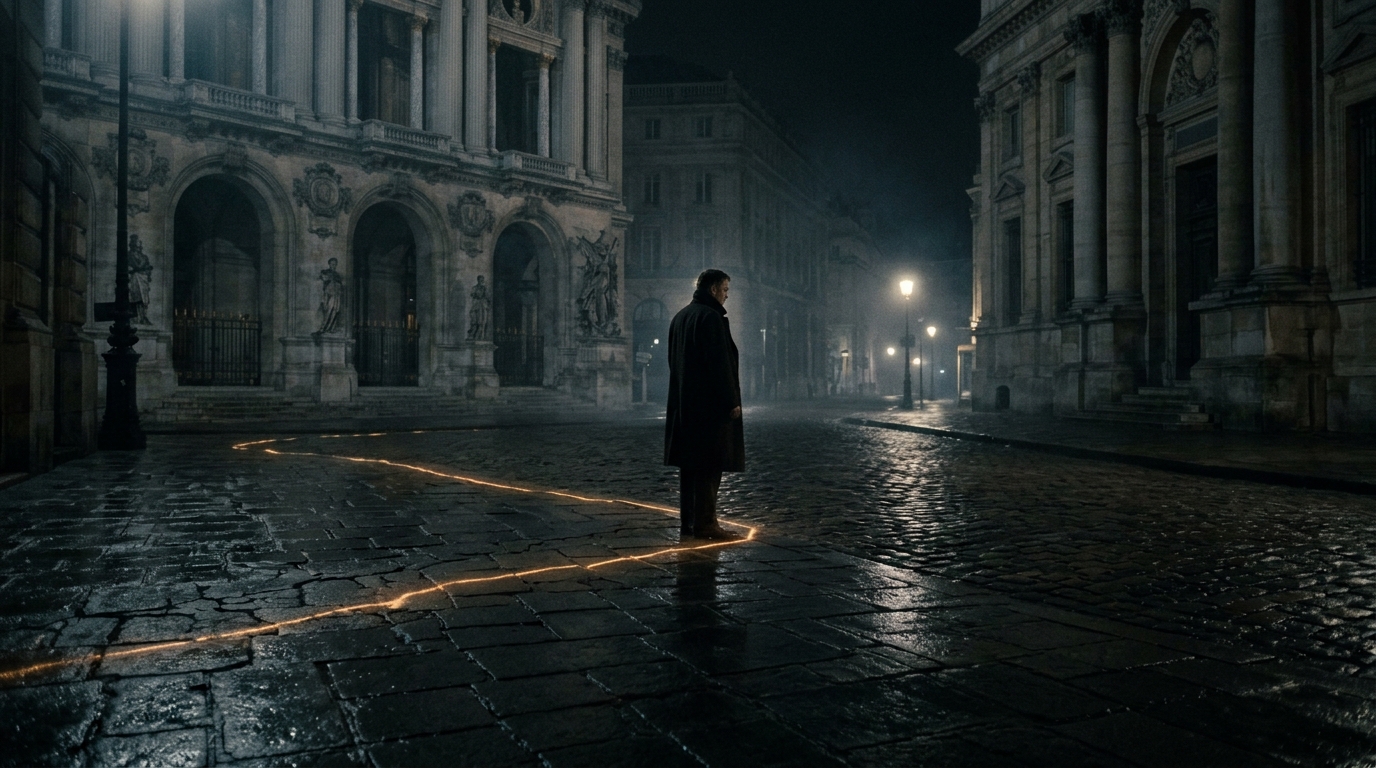
He walked outside the sandbagged building into the dimly lit, freezing night air of Bankova Street. He stood in the open, completely exposed to any sniper nest that might have been watching from nearby rooftops.
Surrounded by his prime minister, Denys Shmyhal, his chief of staff, and his closest advisors, he held up a smartphone, looked directly into the lens, and spoke to the world:
“We are all here. Our military is here. Citizens in society are here. We are all here defending our independence, our state, and it will continue to be this way.”
That 32-second handheld video was worth an entire armored division.
It was the final, devastating blow to Moscow’s psychological blitzkrieg. In 32 seconds, he destroyed the Kremlin’s narrative that the Ukrainian government had dissolved and fled.
He sent an unmistakable message to the ordinary territorial defense volunteers picking up rifles at local depots, to the Ukrainian railway workers maintaining lines under missile barrages, and to the Western world watching in disbelief: We are not going anywhere. If you want this capital, you will have to kill us for it.
I am still crying when editing this part of the article – I am crying for the sheer bravery they displayed – and I am crying for the unfair criticism they have gotten from all over the world. It is brutally unfair!
The statement from Zelenskyy wasn’t PR. That wasn’t a comedian reciting lines for applause. That was an ordinary human being drawing a line in the dirt with his own life, reminding a cynical, comfortable world what sovereignty actually costs.
The raw human reality of that decision and the immense psychological weight of staying in Kyiv are laid bare in President Zelenskyy on The Diary Of A CEO with Steven Bartlett, where he reflects candidly on the brutal cost of command, his family, and why he refused to flee the capital in the opening hours of the invasion.
The Core Truth and The Line in the Dirt
When you clear away the layers of geopolitical rhetoric, propaganda memos, and partisan grievance, you are left with a single, unassailable truth that so many in the comfortable West deliberately refuse to acknowledge:
Vladimir Putin was never afraid of NATO attacking Russia.
Russia possesses thousands of deployed nuclear warheads. Moscow has always known that no Western alliance was ever going to send armored divisions rolling across the Russian frontier.
The entire “NATO expansion” narrative was a manufactured pretext designed for Western consumption, tailored specifically to manipulate the guilt of the Western European left and the nativist reflexes of the American right.
What terrified Vladimir Putin — what gave the autocrats in the Kremlin night sweats — was the terrifying prospect of a free, democratic, thriving Ukraine right on their border.
For centuries, the imperial narrative has treated Ukrainians and Russians as “one people,” bound by shared Slavic heritage, intertwined family trees, and common history. If that very same people could cast off the yoke of Soviet-style kleptocracy, stage two peaceful revolutions in the streets of Kyiv, throw out corrupt puppets, criticize their own government openly, and build a prosperous European democracy with the rule of law, the imperial illusion would shatter forever.
The Russian people would inevitably look across the border and ask the one question no tyrant can survive: “If they can live as free citizens, why are we still living under an autocrat?”
That ideological contagion was the existential threat. Putin invaded not to secure Russia’s borders against foreign tanks, but to extinguish the flame of Ukrainian liberty before its light exposed the rotting reality of his own regime.
Understanding that root cause completely recontextualizes how we must evaluate leadership.
Volodymyr Zelenskyy is not an infallible saint, and he is not a flawless statesman.
As our conversation laid bare, his ledger carries real, documented scars: the costly dismissal of intelligence warnings before the invasion, the insular concentration of power inside the presidential office, the friction with independent anti-corruption bodies, the tensions with his general staff, and the prolonged hesitation over mobilization reform.
In peacetime, those flaws would be the legitimate subject of ferocious parliamentary debate and investigative journalism.
Yet none of those flaws disqualify the historic nature of his achievement under existential fire.
Wartime leadership is not an exercise in bureaucratic hygiene; it is a test of moral gravity. Look at what was accomplished against impossible odds:
- He systematically broke through every Western psychological taboo, turning a reluctant alliance that initially offered helmets and bandages into a coalition delivering Patriots, HIMARS, Leopards, and F-16s.
- He secured EU candidate status and opened formal accession negotiations while the country’s electrical grid was being systematically bombed, permanently severing Ukraine’s centuries-long gravitational pull toward Moscow.
- Under his executive backing, a country without a conventional navy innovated a fleet of indigenous sea drones and cruise-missile tactics that effectively crippled Russia’s Black Sea Fleet, forced Moscow’s warships out of Sevastopol, and broke the maritime blockade on Ukrainian grain.
- Most crucially, he forged a unified civic identity that transcended language, ethnicity, and religion, proving that Ukrainian sovereignty belongs equally to the Ukrainian speaker in Lviv and the Russian speaker in Kharkiv.
All of that began because one man, wearing an olive-green fleece instead of an armored escort’s parachute, stood on a darkened pavement on Bankova Street and refused to run.
During our conversation, when the weight of these realizations hit me, I wept. I felt anger, grief, and awe in quick succession. In our cynical age, admitting that you cried over a political leader or a historical event is often treated as a weakness — proof that you have been manipulated by sentimentality.
I reject that entirely.
Having seen war firsthand — having witnessed the shredded bodies at Qana and stood down bulldozers in South Lebanon — I know that tears and raw emotional reactions are not signs of weakness.
They are proof that your moral nerve endings are still alive. They are evidence that you have not allowed the toxic, deadening cynicism of the modern internet to turn your soul to stone.
When people sit on their couches, chew on snacks, and sneer that Zelenskyy is “just an actor,” that Ukraine is “corrupt,” or that we should stop sending weapons to “end the war faster,” they are not displaying intellectual sophistication.
They are exposing their own profound cowardice. They cannot bear the sight of real courage because it holds an unforgiving mirror up to their own small, comfortable lives.
It terrifies them to realize that there are things in this world worth standing for, suffering for, and dying for.
History will not remember the contrarian podcasters, the cable news cynics, or the cowardly politicians who traded an invaded nation’s survival for a few thousand online impressions.
History will remember that in February 2022, when a massive, brutal autocracy knocked on the door of a sovereign democracy and ordered it to cease existing, the people of Ukraine and their chosen leader did not flinch.
They drew a line in the dirt on Bankova Street, looked the tyrant in the eye, and held the line for every free human being on Earth.
And for those of us who believe in human dignity, that is the only side of the table worth sitting on.
#UKRAINE #ZELENSKYY #BANKOVA #LEADERSHIP #SOVEREIGNTY #GEOPOLITICS #COURAGE