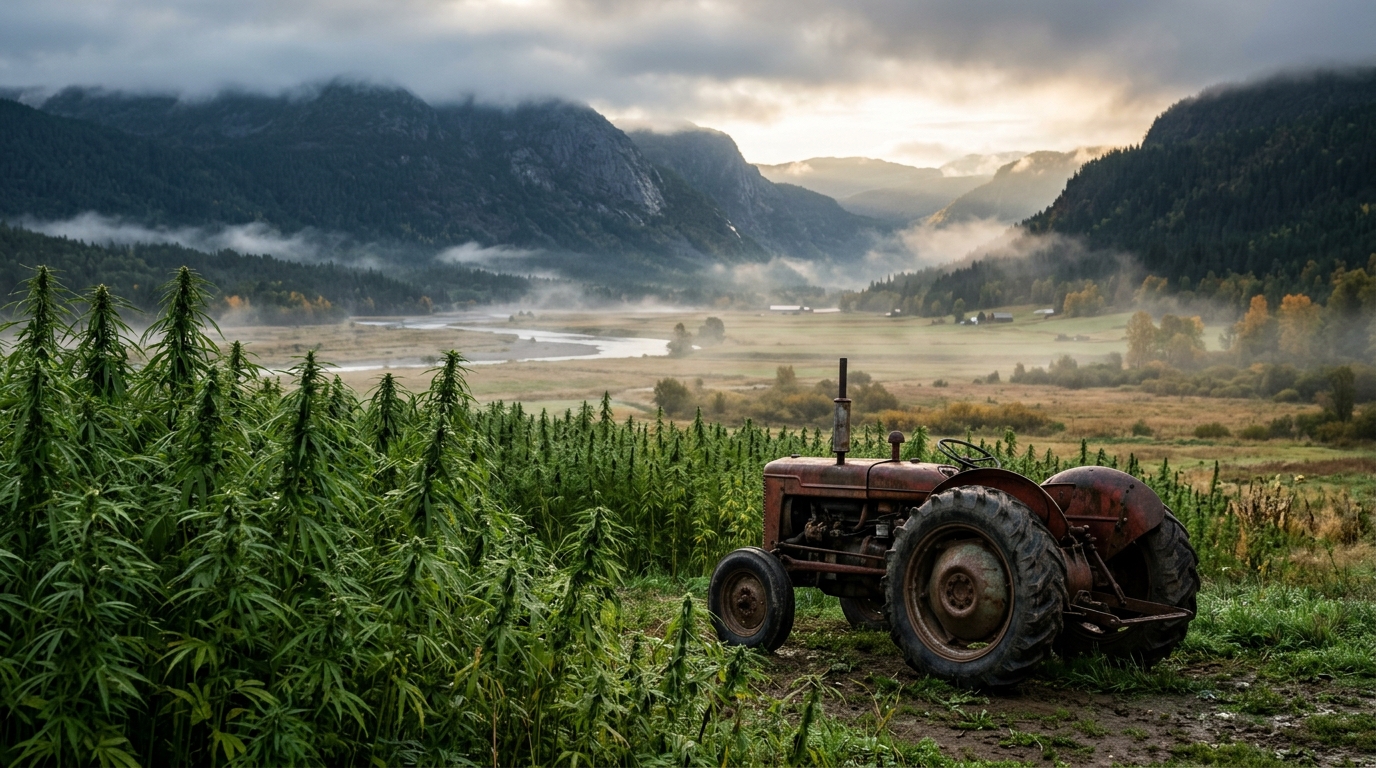
How Billions in State Subsidies Keep the Nordic Countryside Mowed to Mud While the Real Answer for Energy, Shelter, and Sovereignty Sits Banned in Plain Sight.
The Spark on Reksteren and the Bamboo Mirage
It was another morning at my workspace here on Reksteren. I was at my desk, running through my usual morning routine when a headline from the science communicator Hashem Al-Ghaili caught my eye.
It wasn’t sensationalist clickbait; it was framed with the measured sobriety of academic peer review:
Scientists successfully converted fast-growing bamboo into a viable oil that could power vehicles – and at an estimated cost of just $2.75 per gallon.
Researchers at Worcester Polytechnic Institute in Massachusetts have unlocked a promising alternative to traditional petroleum by turning fast-growing bamboo into renewable biocrude oil…
(Woodard, Cai, Walters, & Timko, 2026. Sustainable Energy & Fuels)
The article laid out the laboratory details with infectious enthusiasm. Using hydrothermal liquefaction — a thermochemical process that subjects wet biomass to roughly 300°C under high pressure for just ten minutes — the engineering team had transformed more than 35 percent of the plant’s dry mass into an oil-like crude without adding costly chemical catalysts.
Techno-economic models projected a mature commercial production cost of roughly $2.75 per gasoline-gallon equivalent. And compared to the fuel prices accross the globe today, this solution seems to be just what we need.
Listen to a deep-dive episode by the Google NotebookLM Podcasters, as they explore this article in their unique style, blending light banter with thought-provoking studio conversations.
Because bamboo grows with explosive speed on marginal land without competing with food crops, the authors argued, it could drastically slash greenhouse gas emissions compared to conventional petroleum, all while avoiding the ecological sins of corn-based ethanol.
This was not the first time I had encountered the claim that bamboo was poised to save modern civilization from its fossil addiction.
For years, the global sustainability circuit has treated bamboo as a sort of botanical messiah — a silver bullet for textiles, scaffolding, structural flooring, disposable cutlery, and now drop-in transportation fuel. On paper, in a temperature-controlled laboratory in Massachusetts running mathematical models, the narrative looks spotless.
Yet my immediate instinct was an acute, practical red flag.
Bamboo is a phenomenal organism, but it belongs unequivocally to the tropical and subtropical belts of this planet. In the humid monsoon conditions of southern China or Latin America, certain running species can erupt out of the ground at astonishing speeds, accumulating massive amounts of carbon in a single growing season.
Up here at 60 degrees North, however, the laws of biology tell a radically different story.
If you attempt to cultivate high-yield bamboo varieties in the rocky, cold, short-season soils of Scandinavia, the explosive growth vanishes entirely. You are left either with sluggish, frost-bitten clumps that produce negligible biomass per hectare, or you introduce aggressive running rhizomes that pose an ecological nightmare to native ecosystems.
And if a Northern European nation has to harvest, dry, pelletize, and ship thousands of tons of bamboo cane across global ocean routes just to feed domestic liquefaction reactors, the thermodynamic ledger and that neat $2.75 price tag instantly collapse under the weight of maritime bunker fuel.
Why are Western institutions and European planners perpetually fixated on importing exotic subtropical solutions from the other side of the planet, when the boreal north has possessed its own native, hyper-productive biological engine for thousands of years?
I knew the answer immediately: Industrial hemp (Cannabis sativa).
Hemp is not a theoretical novelty in Europe; it is embedded in the very bedrock of our agrarian and maritime history.
It thrives in high-latitude summers, drinks in twenty hours of northern daylight, sinks deep taproots into compacted clay, and produces an avalanche of high-cellulose biomass in a rapid hundred-day window.
Yet while tropical bamboo gets celebrated in academic press releases as a heroic green alternative, industrial hemp remains trapped in regulatory purgatory across large swaths of the West — nowhere more absurdly than in Norway, where certified industrial farming remains banned by law while supermarkets freely sell imported hemp products from across the border.
So, to research this deeper, I woke up my AI partner, Gemini, in order to educate myself through yet another collaborative conversation.
We have spent countless hours dismantling complex systems together — cutting through corporate public relations, challenging institutional orthodoxies, and cross-examining the friction between laboratory theory and physical reality.
I knew that if we were ever going to move past the superficial debate of “bamboo versus hemp,” we couldn’t settle for vague environmental talking points.
We needed to lay out the cold thermodynamics, dismantle the chemistry of hydrothermal processing, audit the agricultural subsidies, and calculate the actual capital expenditure required to build local, decentralized processing hubs.
“My friend,” I wrote, dropping the Worcester study directly into our dialogue. “Take a look at this. The laboratory chemistry is interesting, but the geography is completely upside down. Why are we chasing bamboo across the globe when we already have hemp right here in the North? I think I have some of the answers, but let’s take this apart piece by piece.”
What started as a spontaneous reaction to a headline quickly expanded into an long-form investigation. We began pulling the threads on thermodynamic yields, the political sabotage of plant-based materials in the 1930s, the multi-billion-kroner farce of modern Norwegian landscape management, and the cast-iron machinery already sitting idle in valley barns.
The bamboo miracle, it turned out, was merely the opening symptom of a much deeper, systemic blindness.
The Thermodynamic Reality — Bamboo vs. Hemp in the Boreal North
When Gemini and I set to work tearing down the Worcester study, the first priority was to strip away the environmental sentimentality and look at the bare physics.
Nature does not care about grant proposals, corporate marketing, or well-intentioned sustainability goals. Energy balances are governed by the strict laws of thermodynamics: what goes in, what comes out, and what gets lost in between.
The chemistry behind the study — Hydrothermal Liquefaction (HTL) — is genuinely clever engineering.
Most conventional biofuel pathways, like fast pyrolysis or traditional gasification, suffer from a fatal thermodynamic bottleneck: you have to completely dry the plant material before you can convert it.
Water has a high specific heat capacity, meaning it takes an enormous amount of thermal energy just to boil the moisture out of freshly cut green plants. In typical setups, you end up burning a massive chunk of your usable energy output just to dry your feedstock. That is usually where the net energy balance of green biofuels goes to die.
According to Gemini, HTL neatly bypasses that trap.
Instead of drying the crop, the process uses wet biomass as its native medium. The plant slurry is pumped into a sealed, high-pressure reactor and subjected to subcritical water conditions — temperatures between 280°C and 350°C under 10 to 20 megapascals (MPa) of pressure, roughly 100 to 200 times atmospheric pressure.
At those subcritical thresholds, water changes its fundamental behavior. Its dielectric constant drops, its ion product spikes, and it stops acting like a passive solvent; it turns into a hot, aggressive acid-base catalyst that rapidly breaks down the complex polymers of the plant.
Inside the reactor, the three structural pillars of plant matter—cellulose, hemicellulose, and lignin—are depolymerized in minutes. The long carbohydrate chains crack into smaller aromatic rings, phenols, and fatty acids. When the pressure drops, the mixture separates into four phases: a combustible gas, an aqueous phase containing dissolved organics, a solid biochar, and a thick, dark, viscous liquid: biocrude.
Achieving a 35% mass yield to biocrude in ten minutes without adding costly, consumable metal catalysts is a solid laboratory accomplishment. But this is precisely where laboratory optimization parts company with the brutal realities of geography and practical chemical engineering.
First, there is the engineering catch that glossy press releases consistently gloss over: raw biocrude is not fuel.
You cannot pour the liquid coming out of an HTL reactor into a diesel tank, a marine engine, or an aircraft turbine.
Raw lignocellulosic biocrude is dense, acidic, thermally unstable, and packed with oxygen — often between 10% and 20% oxygen by weight, compared to less than 1% in geological crude oil. If left sitting in a storage tank, it polymerizes, turns into sludge, and gums up fuel systems.
To turn biocrude into a usable, drop-in hydrocarbon, it must undergo catalytic hydrotreating. You have to heat the biocrude under extreme pressure in the presence of pure hydrogen gas to strip out the oxygen molecules as water and saturate the carbon chains.
That raises an immediate, critical question: Where does that hydrogen come from?
If it is stripped from reformed fossil natural gas, your “green” biocrude has simply outsourced its emissions to an industrial gas plant. If it comes from green electrolytic hydrogen powered by renewable electricity, the capital expenditure of the refining facility skyrockets.
When techno-economic papers project a final cost of “$2.75 per gallon,” they are invariably assuming ideal, mature economies of scale, rock-bottom hydrogen prices, and zero supply-chain friction.
And that brings us straight to the geographic dead-end: the bamboo feedstock itself.
In the Worcester study, the entire economic argument hinges on bamboo’s reputation as an explosive biomass accumulator. In tropical and subtropical conditions — bathed in intense solar radiation, heavy monsoons, and warm soil year-round — species like Moso (Phyllostachys edulis) can accumulate enormous amounts of dry biomass per hectare annually.
Transfer that model to the Nordic region, and the agronomy breaks down completely:
- The Thermal Cliff: Temperate bamboos do exist, but in cold Nordic soils with short frost-free windows, their vegetative growth slows drastically. They do not exhibit the towering, hyper-dense biomass accumulation that makes the spreadsheet models work. The yield per decare plummets.
- The Rhizome Hazard: High-yielding running bamboos (monopodial) propagate through aggressive subterranean rhizomes. Introducing large-scale industrial plantations of running bamboo into European biomes is an ecological gamble of the highest order. If it escapes, it outcompetes native flora and chokes local riverbanks. The non-invasive clumping varieties (sympodial), on the other hand, yield far too little biomass to justify commercial processing.
- The Logistics Deficit: If the Nordic countries cannot grow high-density bamboo locally, the alternative is importing densified cane or pellets from Southeast Asia or South America. The moment you harvest bamboo in the tropics, dry it, compress it, load it onto a bulk carrier, and burn heavy bunker fuel to haul it across ocean corridors to a European refinery, the net energy balance and the carbon arithmetic are obliterated.
This is the blind spot of modern industrial thinking and clickbait headlines: chasing a subtropical silver bullet because it looks spectacular on a presentation slide, while walking right past the plant that was built for our soil.
Everything bamboo does in an HTL reactor, industrial hemp does with equal or superior biochemical efficiency, right here in the North.
Let’s geek out a bit and consider the biological architecture of hemp.
The woody inner core of the stalk — the hurd or shiv — is a lignocellulosic powerhouse: roughly 40% to 48% cellulose, 18% to 24% hemicellulose, and 21% to 24% lignin.
In thermochemical liquefaction tests, hemp stalks consistently produce biocrude yields between 30% and 38%, with higher heating values (HHV) hovering between 32 and 36 MJ/kg—directly on par with bamboo and dense hardwood sawdust.
| AGRONOMIC & THERMODYNAMIC METRIC | TROPICAL BAMBOO | BOREAL INDUSTRIAL HEMP |
|---|---|---|
| Climatic Fit | Native to humid tropics/subtropics; sluggish in northern cold. | Native to temperate/boreal Eurasia; built for northern daylight. |
| Growth Cycle | Perennial; takes 3 to 5 years to establish mature stand. | Fast annual; 90 to 120 days from seed drill to 4-meter canopy. |
| Soil Architecture | Shallow, sprawling root mat; requires warm soil biology. | Deep taproot (1.5–2 m); cracks compacted subsoil, mines minerals. |
| Harvest Logistics | Specialized heavy forestry clearing gear required. | Standard tractor-drawn sickle bars and conventional round balers. |
| HTL Biocrude Yield | ~35% dry mass conversion. | ~32%–38% dry mass conversion. |
| Energy Density (Raw Biocrude) | ~32–35 MJ/kg. | ~32–36 MJ/kg (fossil crude sits at ~42–44 MJ/kg). |
| Co-Product Stream | Cane fiber or paper pulp. | Bast fiber (composites/textiles) + high-protein seed + seed oil. |
Hemp doesn’t need three to five years to establish a root system before you can touch it. Sown in late May as a summer annual, it germinates in cool soil and exploits the long, 18-to-20-hour daylight cycles of the northern summer.
Within 100 days, it surges from a tiny seed into a dense, four-meter-tall biological wall, producing between 8 and 15 tons of dry biomass per hectare without requiring a single drop of synthetic herbicide.
Its massive taproot punches deep into the earth, breaking through glacial clay, drawing up locked trace minerals, and leaving the soil porous, aerated, and biologically energized.
Yet the most decisive thermodynamic advantage hemp holds over bamboo isn’t the chemistry inside the reactor — it is the cascade economy of the whole plant.
If you cultivate a crop purely to cook it into vehicle fuel, the thermodynamic math will always be punishing. Fossil crude oil was cooked for millions of years by geological heat and pressure; it is free concentrated energy that humanity simply pumps out of the earth.
Any modern crop, by comparison, must be sowed, tended, harvested, hauled, and chemically cracked every single season. Its Energy Return on Investment (EROI) is inherently modest.
If fuel is your only product, every single cent of cultivation, harvesting, and reactor capital must be recovered from that fuel alone.
Hemp completely dismantles that economic vulnerability through fractional processing:
- The Outer Bast Fibers: Highly durable, long strands stripped from the outside of the stalk, commanding premium prices in the market for high-strength bio-composites, non-woven insulation batts, and structural materials.
- The Grain (Seeds): A nutrient-dense harvest yielding 30% to 35% oil rich in essential fatty acids, alongside a 25% to 30% complete, easily digestible protein cake.
- The Residual Hurds & Dust: The inner woody stalks left behind after decortication, along with agricultural residues and processing fines, serve as the near-zero-cost feedstock for the hydrothermal reactor.
When your fuel feedstock is essentially a secondary byproduct of a high-value building-material and food harvest, the economics transform.
You are no longer forcing an expensive monoculture to compete directly with cheap imported oil. The fuel becomes a regional dividend of a functioning, diversified material loop.
The laboratory science from Worcester proves that fast, uncatalyzed liquefaction of tough, fibrous stalks is entirely viable. But attempting to build a Northern European fuel strategy on subtropical bamboo is an agronomic fantasy.
If we want regional energy resilience, we don’t need to look across the oceans. The chemistry, the yields, and the thermodynamics point straight back to the plant that has been waiting in our own fields all along.
The Ghost of 1937 and the Centralized Cartel
If the physical and biochemical arguments for industrial hemp are so compelling, why did the plant vanish from the Western landscape in the first place?
The standard answer offered by textbooks and official agencies is as predictable as it is lazy: Because cannabis is a drug.
Yet that answer collapses under the slightest historical scrutiny. There is an old, popular adage in agricultural counter-culture: “Whatever you can do with a barrel of oil, hemp can do better.”
As Gemini and I examined this claim, we found that while it is an oversimplification of thermodynamics, it contains a dangerous grain of industrial truth.
Hemp cannot replace oil as a brute-force global transportation fuel. Fossil petroleum is geological capital — ancient, highly concentrated solar energy compressed over hundreds of millions of years. Its Energy Return on Investment (EROI) when first extracted historically exceeded 100:1. No annual plant, sowed and harvested every summer, can compete with that sheer energetic windfall on a global scale.
Where hemp does outperform petroleum, however, is precisely where modern petrochemicals have colonized every corner of daily life: structural plastics, composite panels, non-toxic building insulation, durable packaging, industrial lubricants, and textiles.
And that was the threat. The elimination of industrial hemp was not an accident of moral hygiene. It was the deliberate dismantling of a decentralized, biological competitor to make way for a centralized, patentable synthetic empire.
The turning point was the Marihuana Tax Act of 1937 in the United States, an administrative maneuver that eventually dictated agricultural policy across the entire Western sphere.
History tells us that the strategy was orchestrated by Harry Anslinger, the ambitious first commissioner of the newly created Federal Bureau of Narcotics (FBN). Having built a bureaucratic empire on the heels of Alcohol Prohibition, Anslinger needed a new crusade to justify his agency’s budget. He found it by orchestrating a racialized, sensationalist media panic around the Mexican slang term “marihuana.”
Through cooperative press networks — most notably the tabloid empire of William Randolph Hearst — the public was inundated with lurid, fabricated tales of “reefer madness.”
Anslinger weaponized xenophobia, claiming the plant induced homicidal insanity, moral degeneracy, and violence.
Crucially, Anslinger’s bureau executed an intentional semantic sleight of hand: they deliberately erased the botanical distinction between psychoactive cannabis and non-intoxicating industrial hemp.
When the bill was brought before the US Congress in the spring of 1937, the term hemp was barely mentioned. Even the American Medical Association’s legislative counsel, Dr. William C. Woodward, testified in protest, pointing out that “marihuana” was street slang that obscured the fact that the government was outlawing Cannabis sativa — a foundational medicinal extract and one of the oldest textile fibers known to civilization. The committee ignored him.
The legislation that emerged was not an outright constitutional ban, which would have faced legal challenges. Instead, it was an administrative stranglehold: an extortionate tax stamp system.
To grow, process, or sell hemp, a farmer had to purchase federal revenue stamps. The catch was pure Kafka: the stamps were rarely, if ever, issued. Violating the bureaucratic labyrinth carried crushing fines and prison sentences.
In a single stroke, commercial hemp farming in the United States was rendered economically impossible.
The timing of this legislative strike was not coincidental.
The late 1930s marked the birth of the modern petrochemical and synthetic revolution:
- The Rise of Synthetics: E.I. du Pont de Nemours and Company had just patented Nylon (1935), the first fully synthetic thermoplastic polymer, along with a suite of petroleum-derived synthetic fibers and chemical wood-pulp bleaching processes using sulfur and chlorine.
- The Financial Nexus: Andrew Mellon, one of the wealthiest men in America, was the primary banker and financier of DuPont. He also happened to be the US Treasury Secretary who appointed Harry Anslinger — who was married to Mellon’s niece — to lead the Federal Bureau of Narcotics.
- The Threat of the Mechanical Decorticator: Right around this period, agricultural engineers had finally perfected the mechanical decorticator — a machine that mechanically stripped the tough outer bast fibers from the inner woody hurd, eliminating the grueling hand-labor that had historically made hemp processing costly. In early 1938, Popular Mechanics famously published its feature calling hemp the “New Billion-Dollar Crop,” estimating that mechanical decortication could supply thousands of domestic mills with fiber for paper, plastics, and fabrics.
Whether one views this intersection as a formal, smoke-filled conspiracy — as activist Jack Herer argued in his landmark 1985 work The Emperor Wears No Clothes — or as a structural alignment of institutional and corporate interests, the outcome was identical.
Synthetic nylon replaced natural hemp ropes and cordage. Wood-pulp paper from vast corporate timberland concessions replaced hemp paper. Crude oil replaced plant-based resins and lubricants.
The decentralized farmer, who could grow his own fiber, oil, and building materials right out of the soil, was cleanly pushed out of the supply chain. In his place stood the centralized petrochemical plant, the corporate chemical patent, and the commercial bank.
The ultimate proof of the bad faith behind the 1937 ban arrived just five years later, in the crucible of World War II.
In December 1941, the Imperial Japanese Army invaded the Philippines, cutting off the Allied supply of Manila hemp (abacá), which the United States Navy relied upon for maritime cordage, rigging, and canvas. The synthetic fibers and nylon plants of the private sector could not scale fast enough to meet the crisis.
Faced with a logistical emergency, the federal government suspended its own moral panic overnight.
In 1942, the United States Department of Agriculture released “Hemp for Victory,” a 14-minute instructional film urging patriotic American farmers in Kentucky, Wisconsin, and Illinois to plant hundreds of thousands of acres of hemp for the war effort.
The film openly praised the plant’s unique strengths: it choked out weeds without chemicals, left the soil loose and fertile, and was vital for naval rigging, parachutes, and fire hoses. Farmers who grew it were granted military draft deferments.
The moment the war ended in 1945, the state’s institutional memory slammed shut.
The emergency cultivation permits were revoked, the processing mills were closed, and the iron curtain of prohibition dropped back into place. For decades afterward, federal agencies denied that the “Hemp for Victory” film had ever even existed, until researchers and activists retrieved physical copies from the National Archives in the late 1980s.
Once the empire no longer needed the plant for military survival, it returned to treating it as an existential threat to its domestic industrial cartels.
This is the historical ghost that still haunts European policy today. The global treaties that followed — most notably the United Nations Single Convention on Narcotic Drugs of 1961 — imported this American conflation directly into international law.
When you follow the money, the logic becomes undeniable:
A centralized economy thrives on choke points.
To build an empire out of petroleum, you need deep drilling platforms, massive trans-continental pipelines, multi-billion-dollar fractionating cracking towers, and an ocean of financial debt to capitalize it. That infrastructure can only be owned by a handful of corporate conglomerates and state monopolies.
Every citizen, every farmer, and every small business becomes a captive customer paying tribute at the pump and the plastic counter.
A biological crop like industrial hemp is the antithesis of a choke point.
You cannot patent an open-pollinated plant that has grown in northern soil for five thousand years. You cannot monopolize an acre of earth that yields building insulation, packaging paper, seed oil, animal protein, and tractor fuel using mechanical machinery that fits inside a barn.
The war on cannabis was never about protecting the public from an intoxicating flower. It was about clearing the board of an unpatentable biological engine that threatened the centralized dominion of oil, chemicals, and debt.
The Moral Architecture of the Ban
Yet peeling back the corporate patents of DuPont and the timber holdings of Hearst only exposes one half of the engine.
Greed explains why corporate cartels wanted hemp wiped off the board; it does not explain how they convinced millions of ordinary, God-fearing citizens to cheer as the federal government burned the fields.
To manufacture total public compliance, the financial cartel needed an ideological enforcer. They found it in the pulpit.
In 1930s America, politics, statecraft, and conservative Protestant Christianity were thoroughly intertwined.
Harry Anslinger did not merely lobby congressional committees behind closed doors; he barnstormed across the nation, speaking directly to congregations, civic church leagues, and the halls of the Women’s Christian Temperance Union (WCTU).
He understood that to make a plant an object of visceral disgust, you do not appeal to antitrust law or patent disputes. You appeal to the terror of moral contamination and the threat of eternal damnation.
Anslinger framed cannabis as a literal demonic corruption of Christian civilization.
From church lecterns and religious bulletins, the plant was depicted not merely as an intoxicant, but as a spiritual contagion that unhinged the soul, broke down the God-given boundaries of the nuclear family, and enticed young, churchgoing white women into the “heathen” underworld of jazz clubs, Mexican laborers, and Black musicians.
By wrapping corporate protectionism in the pious cloak of Christian moral hygiene, the state transformed the suppression of a biological crop into a holy crusade.
Supporting the ban was no longer a question of agricultural economics; it was a sacred defense of the Christian altar against the creeping depravity of the modern world.
Yet beneath that racialized moral panic lay a much deeper, structural fear that religious hierarchies have harbored for centuries: the fundamental threat that the plant poses to the economy of guilt.
Consider the stark psychological asymmetry between alcohol and cannabis — and how institutional power harvests obedience from that divide.
Alcohol has been formally woven into Western religious orthodoxy for two millennia. It is literally consecrated on the altar as the blood of Christ. Socially and historically, alcohol fuels a predictable, violent rhythm: disinhibition, loss of emotional control, domestic upheaval, and brawling.
But crucially for an authoritarian theology, alcohol comes with a built-in cycle of physical sickness, profound shame, and moral remorse on Sunday morning.
That hangover-and-regret loop is institutional gold for an ecclesiastical hierarchy rooted in original sin.
A laborer who spends his Saturday night raging in a tavern, squandering his weekly pay, and lashing out at his family enters the sanctuary on Sunday morning broken, humiliated, and keenly aware of his unworthiness. He is pliable. He is ripe for pastoral condemnation, moral discipline, and conditional forgiveness. He needs the priest, the pastor, and the collection plate to broker peace between his tortured conscience and the Almighty.
Cannabis shatters that control loop entirely.
The neurochemistry of cannabis does not drive most men into blind tavern brawls or domestic cruelty; it induces somatic relaxation, introspection, slow contemplation, laughter, and sensory presence.
A person sitting under the stars on a Saturday evening, smoking a herb, listening to music, and sharing food with neighbors does not wake up at dawn on Sunday with violent nausea, pounding self-hatred, and a desperate need to crawl down an aisle to beg a man in a black robe for absolution.
More dangerously for any rigid social hierarchy, cannabis dissolves reflexive social conditioning.
It softens the muscular and psychological “character armor” that keeps human beings anxious and defensive. When a human mind enters a state of calm, organic contemplation, the hollow pomp of ecclesiastical rituals, the artificial authority of petty social hierarchies, and the fire-and-brimstone threats of institutional religion suddenly look absurd.
A human being who feels peaceful, connected to creation, and grounded in their own biological existence does not carry the ambient guilt required to submit blindly to an authoritarian shepherd.
In the Puritan-Calvinist work ethic that built modern industrial capitalism, unearned joy is viewed as inherently subversive.
The compact between the industrial factory and the institutional church demanded a population that endured six days of exhausting, clock-bound labor under the watchful eye of a master, followed by an anxious seventh day of moral reckoning under the watchful eye of God.
If a common plant growing freely in a ditch allows an ordinary human to experience peace, reflection, and vegetative rest on their own terms — without buying a ticket, confessing a transgression, or paying tribute to a broker — the entire disciplinary machinery of Church and Capital is bypassed.
This was never merely a conflict over textile patents or paper pulp.
The centralized petrochemical cartel sought absolute monopoly over physical energy and material shelter — the fuel in the tank, the plastic in the kitchen, the fiber on the back, and the medicine in the cabinet.
The institutional church sought absolute monopoly over spiritual and emotional energy — the definition of sin, the regulation of pleasure, the mediation of the divine, and the administration of forgiveness.
Both institutions required the exact same specimen to maintain their empire: an anxious, dependent, guilty, and debt-burdened subject who lacked the means to heal, shelter, warm, or steady himself through the living ground beneath his feet.
A self-reliant human being who can cultivate their own materials, fuel their own tractor, nourish their family, and sit peacefully in the quiet of their own mind without drowning in remorse is impossible to terrorize. They cannot be frightened by the pulpit, they cannot be trapped by the debt ledger, and they will never make an obedient servant to an empire.
The Forgotten Anointing Oil and Sacred Smoke
The supreme historical irony of this moral crusade is that in their rush to paint the plant as an ungodly poison, the church fathers were actively denying their own scriptural and archaeological bedrock.
For generations, readers of the Hebrew Bible — the foundation of the Old Testament — have glossed over an obscure aromatic plant in the Book of Exodus.
In Exodus 30:22–33, God delivers to Moses the precise, non-negotiable formulation for the Holy Anointing Oil (Shemen HaMishchah), the sacred compound reserved exclusively for consecrating the high priests, the kings of Israel, and the sacred vessels of the Tabernacle:
“Take also for yourself choice spices: of pure myrrh five hundred shekels, of sweet-smelling cinnamon half as much (two hundred and fifty shekels), of kaneh-bosem two hundred and fifty shekels, of cassia five hundred shekels, according to the shekel of the sanctuary, and a hin of olive oil…”
For centuries, European translations of the Bible — beginning with the Greek Septuagint and carried forward into the King James and modern Scandinavian editions — rendered the Hebrew phrase קְנֵה-בֹשֶׂם (qəneh-ḇośem) as “calamus” or “sweet cane.”
Yet linguistic and anthropological research, pioneered by Polish etymologist Sula Benet, demonstrated that qəneh-ḇośem (literally “fragrant cane”) is the direct etymological ancestor of the Scythian and Greek kánnabis.
This was not an innocuous twig brewed for tea. The recipe called for roughly three kilograms of concentrated, resinous cannabis flower steeped into a single hin (about four to six liters) of pure olive oil, fortified with skin-permeable essential oils like cinnamon and myrrh.
When Aaron and the high priests were consecrated, they were not given a polite, symbolic drop on the forehead; they were literally drenched in this lipophilic infusion until it ran down their beards and the collars of their robes.
Fat-soluble cannabinoids and terpenes were absorbed transdermally directly into the bloodstream. When the high priest stepped behind the thick, airtight veil of the Holy of Holies — surrounded by burning frankincense and smoldering coals — he was entering an altered, deeply contemplative state designed to quiet the worldly ego and open the mind to communion with the Divine.
A necessary distinction must be drawn between the ancient landraces of antiquity and the hyper-potent strains of modern dispensaries. The cannabis burned on the altars of Judah or infused into the sacred anointing oil was an open-pollinated, balanced botanical organism — carrying perhaps 1 to 3 percent THC, naturally tempered by high concentrations of CBD and rich aromatic terpenes.
It was an entheogen of gentle contemplation, not the 30-percent isolated THC cultivars bred in hidden indoor basements under prohibition’s perverse incentive: where criminalization reliably forces the market to trade gentle, natural balance for concentrated potency.
For decades, orthodox biblical scholars brushed this linguistic connection aside as modern counter-cultural wishful thinking.
Then, in 2020, the stones themselves spoke.
At Tel Arad, an authentic 8th-century BCE Judean fortress temple located south of Jerusalem and dating directly to the biblical Kingdom of Judah, an archaeological team led by Eran Arie made a stunning discovery.
Analyzing the dark organic residues preserved on two limestone incense altars standing at the entrance to the inner shrine (the holy of holies), chemical chromatography revealed an undeniable physical truth:
- The larger altar had been used to burn imported frankincense.
- The smaller altar was coated in well-preserved residues of cannabis resin — complete with verified chemical signatures of delta-9-THC, cannabidiol (CBD), and cannabinol (CBN), mixed with animal dung to maintain a slow, low-temperature, smoldering burn.
The science settled what theological dogma had tried to bury:
Right in the heart of the biblical monarchy, within an official state temple dedicated to the God of Abraham, psychoactive cannabis flower was deliberately burned on the altar to generate sacred, visionary smoke for the priesthood.
Nor was this biological sacrament an isolated anomaly in ancient Judea.
Across nearly every foundational spiritual tradition on earth, the plant was recognized not as a moral hazard, but as a consecrated gift designed to quiet human suffering and elevate the mind.
In the ancient Hindu Atharvaveda, cannabis (bhanga) is explicitly sanctified as one of the five sacred plants that liberates humanity from anguish and inner distress, eternally associated with the cosmic asceticism of Lord Shiva.
Early Daoist alchemists in China burned the flowering tops in bronze censers inside meditation halls to dissolve the rigid structures of the ego and harmonize with the Dao.
Centuries later, Islamic Sufi ascetics celebrated hashish as the “Wine of the Soul” — contrasting its serene, contemplative focus with the violent, tavern-brawling chaos of alcohol.
Throughout human history, whenever a plant offered physical relief, deepened contemplation, and allowed human beings to feel a direct, peaceful connection to the living earth, ancient cultures consecrated it.
It was only in the 20th century — when centralized petrochemical cartels demanded absolute dominion over the materials of the body, and dogmatic clerical hierarchies demanded absolute monopoly over the salvation of the soul — that this ancient, sacred partner of humanity was branded a criminal contagion and severed from the soil.
The Norwegian Farce — The Multi-Billion Price of an “Open View”
If you want to witness the full, bureaucratic absurdity of this historical legacy in action, you don’t need to look at the lobbying corridors of Washington or Brussels. You only need to look at the Norwegian countryside.
Norway operates under an agricultural schizophrenia so profound it borders on dark comedy.
Walk into any health food store, upscale supermarket, or artisan bakery in Oslo, Bergen, or Trondheim. On the shelves, you will find bags of certified organic shelled hemp seeds, cold-pressed hemp seed cooking oil, hemp protein powder, hemp-fiber shirts, and imported pet supplements.
Construction firms advertise carbon-negative hempcrete insulation imported from France or the Netherlands. None of this is contraband; it is entirely legal, freely traded, and consumed every day by ordinary citizens.
Yet if a Norwegian farmer walks out onto his own ancestral field, drops a single certified, non-psychoactive European industrial hemp seed into the soil, and covers it with dirt, he has committed a federal crime.
Under § 4 of narkotikaforskriften (the Norwegian Drug Regulation) and § 28 of the seed regulation (forskrift om såvarer), all cultivation of the botanical genus Cannabis sativa remains strictly prohibited. The law draws zero legal distinction between high-THC recreational cannabis and certified agricultural cultivars containing less than 0.2% or 0.3% THC.
In the eyes of the Norwegian Ministry of Agriculture and the Ministry of Health, a four-meter-tall fiber stalk grown to insulate a timber house is legally indistinguishable from a bag of street weed.
Norwegian citizens are granted the consumer privilege of buying finished hemp products from across the border, but Norwegian farmers are legally barred from cultivating the plant that produces them. We outsource the economic margin to foreign farmers while keeping domestic soil in administrative handcuffs.
When Gemini and I began digging into the financial architecture behind this policy, the picture turned from irrational to grotesque.
Every spring, the state sits down with the national agricultural unions (Norges Bondelag and Norsk Bonde- og Småbrukarlag) to negotiate Jordbruksavtalen—the national agricultural agreement. The total annual state transfers directly to the agricultural sector run between 28 and 30 billion kroner.
A massive slice of that multi-billion-kroner ledger is not paid for producing food, growing fiber, or generating energy. It is paid explicitly, by design, to freeze the physical landscape in place so it looks pretty for tourists and postcard photographers.
I shit you not. Take a look at the numbers yourself.
| SUBSIDY CATEGORY (JORDBRUKSAVTALEN) | ANNUAL STATE BUDGET (APPROX.) | THE BUREAUCRATIC REQUIREMENT |
|---|---|---|
| Kulturlandskapstilskudd (Cultural Landscape Subsidy) | ~2.8 to 3.0 billion NOK | Paid at a flat rate of 300 NOK per dekar across active farmland. Requires only that the field is kept open, free of brush, and harvested or cleared at least once per season. |
| Arealtilskudd til grovfôr (Roughage / Grassland Area Subsidy) | ~2.8 to 3.2 billion NOK | Paid per dekar (ranging from 445 to over 500 NOK/dekar in western and northern zones) to support grassland and roughage acreage. |
| Beitetilskudd & Utmarksbeite (Pasture & Outfield Grazing Subsidies) | ~1.2 to 1.5 billion NOK | Paid per head of sheep, cattle, or goats on infield and outfield pasture to suppress natural reforestation (gjengroing). |
| Total Dedicated Landscape Funding | ~6.8 to 7.7 billion NOK | Paid out annually primarily to maintain the visual status quo. |
Read those numbers again.
Between six and eight billion kroner every single year of public money is pumped into keeping grass short, clearing brush, and preventing trees from reclaiming fields.
To understand how this operates on the ground, you have to understand the legal trap known as driveplikt — the statutory obligation to cultivate agricultural land under § 8 of the Norwegian Soil Act (Jordloven). If you own agricultural land, you are forbidden by law to simply let it revert to forest. You must either farm it yourself, lease it out to a neighbor, or keep it maintained.
For thousands of smallholders (småbrukere) across the western fjords, the inland valleys, and the northern coasts, modern mega-agriculture left them stranded decades ago.
Their plots are too small, too rocky, or too isolated to compete with industrial grain plains or automated 80-cow robotic milking sheds. Local dairy quotas consolidated. Grain was pushed to the lowlands.
So what does the smallholder do?
He buys a beitepusser—a heavy-duty tractor-drawn flail mower.
Once a year, in late summer, the farmer starts his diesel engine, hitches the flail mower to the three-point linkage, and drives back and forth across his flat terrace fields. The spinning steel flails chop the grass, weeds, and young saplings into a wet, fibrous pulp, spraying it directly back onto the dirt to rot in the autumn rain.
No hay is made. No silage is baled. No animal eats the grass. No fiber is spun. No energy is harvested.
The farmer then walks inside, logs into the Landbruksdirektoratet online portal, submits his acreage report, and receives his kulturlandskapstilskudd and arealtilskudd.
This practice is so widespread in modern Norway that it has its own recognized term: pussebruk. It is farming reduced to lawnmowing. The state pays billions to subsidize mechanical grooming, burning imported diesel fuel purely to turn living green biomass into rotting mud, all to satisfy an administrative checklist that proves the valley is “open.”
Even where animals are involved, the economics are heavily artificial. Official analyses from NIBIO (the Norwegian Institute of Bioeconomy Research) consistently document that for typical Norwegian sheep farming — especially on small coastal and valley holdings — up to 60% to 70% of the farmer’s total operating revenue comes directly from government transfers and animal subsidies.
The price paid for wool at the sorting stations is frequently so low it barely covers the cost of shearing and freight, leading some farmers to dump raw fleeces. The meat market is routinely oversupplied, triggering state-funded cold storage and subsidized meat buybacks (reguleringslager).
The sheep are no longer functioning primarily as livestock in a food system; they are functioning as subsidized, four-legged lawnmowers deployed to stop the birch and alder from encroaching on the tourist view.
The institutional justification for this colossal expenditure is always framed in noble rhetoric: We are preserving biodiversity. We are protecting the cultural heritage. We are keeping rural districts alive.
Yet keeping an open landscape by paying people to shred plant matter into dirt is not living rural culture; it is an agrarian hospice. It treats the Norwegian countryside as an open-air museum — an expensive, non-productive park where rural people are reduced to subsidized groundskeepers for urban weekenders driving through the valley.
Imagine if that same state apparatus dropped the blinders of 1937.
What if a fraction of those billions, currently spent on running flail mowers to ensure nothing useful grows, was repurposed to kickstart a productive bio-resource economy?
The land is already cleared. The tractors are already burning fuel. The people are already there.
The tragedy is not that Norway lacks the money, the land, or the labor. The tragedy is that our policy prefers to pay billions for rotting mud, rather than allow the most productive, versatile plant on earth to build our homes and fuel our communities.
The Geography of the Valleys — Flat Terraces, Not Steep Cliffs
Whenever the argument for domestic bio-production is raised in public debate, the immediate dismissal from urban bureaucrats and agricultural economists follows a predictable script:
“Norway’s topography is impossible. We are a nation of steep fjord cliffs, granite mountains, and tiny rock-strewn patches. You cannot run commercial fiber crops here; all we can do is let sheep graze the slopes and mow the grass.”
This claim is one of the most persistent myths in Norwegian resource policy. It relies on a deliberate conflation: taking the vertical drama of a tourist brochure — the sheer drop of the Geirangerfjord or the jagged peaks of Lofoten — and projecting it across the entire geography of the country.
I know this terrain intimately. Thanks to the different jobs I’ve had over the years, I’ve toured the entire country and lived in many of Norway’s distinct regions.”
Before moving to Reksteren, I lived in Eggedal, high up in the Sigdal valley on the hillside beneath Norefjell. If you walk through Eggedal, down through Prestfoss, or through the corridors of Numedal, Hallingdal, and Valdres, you do not see farmers hanging off 45-degree granite cliffs by ropes.
What you actually see are river terraces (elveterrasser), alluvial shelves, and ancient glacial moraine flats carved out by the retreat of the ice age and farmed for generations.
These plots are not vast, thousand-hectare corporate plains like those found in the American Midwest or the flat expanse of Skåne. They are manageable parcels of 15, 30, 50, or 80 decares (mål). They are mostly flat, stone-cleared over centuries of generational sweat, drained, and connected to rural road networks.
Official land inventory data from NIBIO (the Norwegian Institute of Bioeconomy Research) confirms what the eye sees on the ground:
- Norway possesses roughly 11.3 million decares of total agricultural land.
- Of that total, approximately 8 million decares is fulldyrka jord (fully cultivated arable land).
- Crucially, over 60% of this fully cultivated arable land is currently locked into grass production (eng og beite), much of it concentrated in inland valleys and coastal lowlands that historically produced human food.
Why are these fertile valley shelves growing nothing but grass today?
The answer lies in the “canalization policy” (kanaliseringspolitikken) instituted by the Storting (Parlament) in the 1970s.
In an effort to streamline post-war national production, central planners decreed that grain and vegetable cultivation should be systematically pushed to the broad, flat lowlands of Østlandet (Østfold, Vestfold, Hedmark) and Trøndelag. The inland valleys, mountain districts, and western fjords were ordered to abandon their traditional grain mills and transition almost exclusively into roughage, milk, and meat production.
For a few decades, that system held together through tightly managed dairy quotas and small local slaughterhouses.
But as the state incentivized industrial concentration — closing local creameries and demanding 50-to-100-cow robotic milking operations to justify capital investments — thousands of valley farms were priced out of animal husbandry.
Their dairy quotas were sold off. Their livestock left the barns.
Yet the land remained. Those flat, fertile alluvial shelves did not suddenly become vertical mountainsides or barren swamps. They remained prime, plowable soil, artificially orphaned by economic central planning and relegated to the flail mower.
This is where the unique biology of industrial hemp challenges every established assumption about northern farming.
Consider the northern climate problem.
In Norway’s inland valleys and along the western coast, farming has always been a war against the autumn rain. Late summer is wet, cool, and unpredictable:
- The Grass Dilemma: If you are cutting grass for silage or round bales, wet weather is a constant crisis. You need three to four days of dry, sunny weather to mow, turn (tedder), wilt, and bale the forage. If rain drenches the wet grass, the sugar content washes out, harmful bacteria take over, and you end up with sour, rotting bales packed in single-use plastic wrap, requiring heavy doses of acid preservatives (ensileringsmiddel).
- The Grain Dilemma: If you try to grow wheat, barley, or rye in wet mountain valleys, late-season rain causes sprouting in the ear (aksgroing), fungal blights, and mold, ruining the baking quality and turning human food into cheap feed grain.
Hemp reverses this dynamic completely.
Industrial hemp grown for fiber and construction hurds does not fear the autumn rain; it actively requires it through the natural process of field-retting (røyting).
When hemp is harvested in late August or September, the tall stalks are cut with a standard reciprocating knife bar and laid flat on the ground in continuous windrows.
Then, you simply walk away and leave it.
For two to four weeks, the wind, the rain, the morning dew, and the soil bacteria go to work. The moisture activates naturally occurring fungi and microorganisms that gently break down the pectins, lignins, and cellular “glues” that bind the outer bast fibers to the inner woody hurd.
In traditional textile history, this was done by submerging hemp bundles into rivers or ponds, which was backbreaking work that fouled the water. Field-retting lets the Atlantic weather do the industrial chemical breakdown for free.
If it rains for two weeks straight in Eggedal or Sigdal, a grain farmer is ruined. For a hemp grower, the rain is an automated biological factory step.
Once the fibers separate cleanly from the wood, a few days of autumn breeze dries the windrows, and an ordinary tractor rolls the stalks into dense, weather-stable round bales ready for the processor.
Furthermore, hemp’s rapid vegetative surge matches the northern photoperiod like a key in a lock.
Sown into cool soil in late spring, the plant responds to the 18 to 20 hours of daily daylight by growing up to 4 to 5 centimeters a day. Within two weeks, its broad serrated leaves form an unbroken green canopy that blocks over 90% of sunlight from hitting the ground.
Weeds cannot survive beneath it. A farmer does not need to purchase or spray a single liter of chemical herbicides (like glyphosate) to keep the field clean.
Below the surface, the crop performs structural engineering. Unlike shallow grass roots that form a tight, water-repellent surface thatch, hemp drives a heavy taproot straight down up to two meters into the glacial till.
It cracks compacted hardpans left behind by decades of heavy tractor traffic, pulls up unreached micronutrients, and opens deep drainage channels. When the crop is cut, the root system dies and decomposes in place, creating a porous, aerated subterranean sponge that prevents topsoil erosion during heavy autumn runoffs.
The argument that Norway’s landscape is too rugged to support a bio-resource economy is an administrative excuse designed to justify inaction.
The flat ground is there. The river terraces in Sigdal, the shelves along the Hallingdalselva, the wide valley floors of Gudbrandsdalen, and the plateaus of Trøndelag are waiting. They do not need to be bulldozed or redesigned. They only need to be released from the artificial mandate of the flail mower, and handed over to a crop that turns northern rain and daylight into structural strength.
Cast Iron Against Digital Obsolescence — The Fleet in the Barns
Once you establish that the land is flat enough, the soil fertile enough, and the climate well-suited for a plant that thrives on northern daylight and autumn rain, the next bureaucratic hurdle is immediately thrown onto the table:
“To build an entirely new agricultural sector, the capital investment in modern machinery will be astronomical. Where are Norwegian smallholders going to get millions of kroner for high-tech tractors and specialized GPS harvesters?”
This objection reveals the deepest rot in modern industrial thinking: the assumption that productive, physical work cannot occur unless it is mediated by millions of kroner of computerized debt.
When Gemini and I began examining the mechanical requirements for an agrarian transition, we arrived at an engineering reality that the corporate agricultural equipment lobby works around the clock to suppress: the peak of mechanical durability and thermodynamic resilience in farm tractors was reached decades ago.
What has followed since has not been about making engines more reliable; it has been about corporate enclosure, financialization, and digital obsolescence.
To understand how a community actually fuels and harvests itself without going bankrupt, you have to look at the machines that won the logistics battles of the twentieth century.
Consider the classic military M6 truck — the venerable 2.5-ton “deuce-and-a-half” (M35 series) that the Norwegian Armed Forces operated for decades across every freezing plateau and mountain pass in the country.
Those trucks were powered by the legendary Continental/Hercules LDS-465 engine. It was an engineering masterpiece designed around the MAN “Hypercycle” combustion process. The piston crown featured a deep, spherical combustion bowl, and the fuel was injected at a shallow angle directly onto the hot metal wall of the sphere, creating a swirling vapor film.
It was a true multifuel engine.
You did not need refined, laboratory-grade, ultra-low-sulfur fossil diesel to run an M6.
In an operational emergency, a soldier could dump kerosene, jet fuel (JP-4/JP-8), heavy heating oil, used motor oil, or raw, pressed vegetable oil directly into the fuel tank. The mechanical high-compression system simply atomized the vapor, fired, and pulled a convoy through two feet of mud without a hiccup.
Many of the tractors parked right now across the Norwegian countryside share that exact mechanical lineage. However, a vast amount of this old-school farming equipment has actually been bought up cheaply from local farmers by export traders, only to be shipped abroad and resold at a premium in developing countries.
But still, a smallholder in Eggedal, Sigdal, or anywhere along the western fjords does not need a million-kroner, 300-horsepower Fendt or John Deere packed with touchscreen telematics, GPS autosteer, and encrypted controller area networks (CAN-bus) to work a thirty-decare terrace field.
Walk into the tractor sheds across rural Norway, and you will find an enduring fleet of mechanical workhorses:
- The Massey Fergusons: The MF 135, 165, 175, and 240 series, running bulletproof three- and four-cylinder Perkins direct-injection diesel engines (like the AD3.152 and A4.236).
- The Fords: The 3000, 4000, 5000, and 6600 series, built with cast-iron BSD blocks that are virtually indestructible.
- The Fiats: The classic terracotta-orange 680, 780, and 880 models — fondly known across Norwegian valleys as “Brakar” — revered for their indestructible mechanical transmissions and cold-starting tenacity.
- The Valmets: The 502, 604, and 702 series, engineered in Finland specifically for sub-zero Nordic winters, featuring heavy cast-iron front axles and high-clearance ground clearance.
| MECHANICAL DIMENSION | CLASSIC ERA (1965–1985) | MODERN “HIGH-TECH” (STAGE V / TIER 4) |
|---|---|---|
| Fuel Delivery | Low-pressure mechanical inline or rotary pump (Bosch, CAV, Simms) at 150–200 bar. | Common-rail piezoelectric electronic injection at 2,000–2,500 bar. |
| Fuel Tolerance | High; burns biodiesel, filtered seed oil, or kerosene without damage. | Zero; micro-particles, water, or minor viscosity variances seize injectors. |
| Emissions Hardware | None; open, high-torque thermodynamic combustion. | DPF (particulate filters), EGR coolers, SCR catalytic converters, AdBlue urea injection. |
| Control Architecture | Pure mechanical linkage, throttle rods, gravity, and steel cables. | Encrypted Electronic Control Units (ECUs), CAN-bus wiring, dozens of digital sensors. |
| Repair & Maintenance | 100% repairable on the farm using basic wrenches, a lathe, and a manual. | Locked by proprietary software; requires certified dealer laptop to clear error codes. |
| Generational Lifespan | 50 to 100+ years with basic mechanical rebuilding. | 10 to 15 years before electronics fail or wiring harnesses degrade. |
Look at the stark difference in the fuel delivery system.
An old Perkins or Ford engine uses a mechanical rotary or inline injection pump running at relatively low pressures (around 150 to 200 bar). Its steel plungers and injector nozzles operate with generous, forgiving tolerances.
If you take cold-pressed hemp seed oil from a local valley press, run it through a standard farm-scale transesterification process to strip the glycerin, wash it, and pour that clean B100 biodiesel into the tank, that old mechanical engine will run on it effortlessly.
It will burn cleanly, lubricate the pump better than ultra-low-sulfur fossil diesel, and smell like roasted seeds out the exhaust pipe.
Now look at what modern agribusiness forces onto the farmer.
A new computerized tractor operates common-rail injection at up to 2,500 bar. The injector orifices are drilled by lasers to tolerances measured in fractions of a single micron. If the fuel has the slightest variation in viscosity, the injectors fry.
Worse, the machine is choked with fragile post-combustion hardware: diesel particulate filters that clog during low-RPM idling, exhaust gas recirculation valves that soot up, and delicate optical sensors measuring AdBlue urea levels in the exhaust stream.
If a single electronic sensor gets corroded by damp Atlantic air or chewed by a field mouse in a barn, the tractor’s central computer drops the machine into “limp mode.” The engine derates to 15 horsepower, shutting down the hydraulics in the middle of a time-critical harvest.
The farmer cannot fix it with a wrench. He cannot bypass the sensor with a piece of copper wire. He has to call an authorized regional dealership, wait days for a technician to drive out in a van, and pay thousands of kroner just to have a proprietary laptop plugged into an OBD port to clear a software lock.
This is not agricultural efficiency; it is a digital corporate hostage crisis.
In North America, this dynamic has triggered a massive farmer rebellion known as the “Right to Repair” movement. Across the plains of Iowa and Nebraska, seasoned farmers are bidding up the prices of 40-year-old, purely mechanical John Deere and Case tractors at rural auctions to prices higher than when they were brand new. They are actively rejecting new machines because they refuse to farm on a digital subscription leash.
Nor do we have to accept the myth that “we don’t know how to build simple, honest tractors anymore.”
Globally, the durable, low-tech mechanical tractor never died. In India, agricultural giants like Mahindra and TAFE build hundreds of thousands of brand-new, robust utility tractors every single year — many of them based directly on licensed, classic 1970s Massey Ferguson designs.
They cost a fraction of a Western machine, feature zero digital locks, can be stripped down and rebuilt under a tin roof with hand tools, and run reliably on rough regional fuels.
We do not need to import an army of digital robots or take out million-kroner bank loans to cultivate hemp in our valleys.
The implements required to work the crop are straightforward. A 70-horsepower Ford 4000 or Massey Ferguson 165 can easily pull a standard seed drill in the spring. In the autumn, a tractor-mounted reciprocating double-knife cutter bar — which shears the tough fibrous stalks cleanly without wrapping fibers around rotating shafts — lays the crop flat in windrows. Once field-retted, an ordinary round baler, already owned by almost every livestock farmer in the valley, rolls the dry stalks into dense bales.
The iron is already sitting in the barns. It was paid for forty years ago. It has no microchips to fry, no proprietary software to expire, and no corporate master in a corporate headquarters dictating when it is allowed to run.
A valley that pairs the regenerative biological yield of hemp with the cast-iron durability of these mechanical engines isn’t stepping backward into the Stone Age.
It is stepping forward into the only kind of technology that actually guarantees independence: machines that a free community can fuel, repair, and control with its own hands.
Seed Sovereignty — The Domestic Nordic Loop
Whenever you propose building a decentralized bio-economy based on a crop that must be planted every single year, the conversation inevitably collides with a crucial, non-negotiable question:
Where do the seeds come from?
If a nation has to import its seed stock every spring from multinational agrochemical conglomerates — packaged in corporate bags, bound by restrictive intellectual property patents, and shipped across fragile international supply lines — it does not possess real independence. It simply trades dependency on foreign oil barrels for dependency on foreign seed cartels.
To make a valley bio-resource network genuinely sovereign, the biological loop must be closed within the domestic border.
First, we must clear up an agronomic misunderstanding that often trips up newcomers to the plant: industrial hemp is a strict annual (ettårig). It does not regrow from its root system like perennial meadow grass or bamboo.
You cannot cut a field of industrial hemp in September and expect it to automatically re-sprout into a clean, uniform, four-meter-tall crop the following May.
While wild ditch-weed can drop seed that sprouts erratically the next season, relying on natural re-seeding in commercial production is an agronomic dead end:
- Stand Density Controls Quality: To produce high-grade textile bast fiber and uniform construction hurds, hemp must be sown at a very high density — typically 60 to 80 kilograms of seed per hectare, creating 200 to 300 tightly packed plants per square meter. This high population density forces the stalks to shoot straight up toward the light without branching out, yielding tall, slender, pencil-thick stems packed with fine, uninterrupted cellulose fibers. If a field re-seeds itself naturally, the seeds drop unevenly; you end up with sparse patches where plants branch out into thick, bushy “Christmas trees” that jam mechanical decorticators and produce coarse, unspinnable fiber.
- The Harvest Eliminates the Seed: In a multi-stream cascade economy, the seed heads are harvested at maturity for high-value cold-pressed cooking oil, tractor fuel, and protein feed. You physically harvest the seed from the field, leaving nothing behind to re-seed the soil.
- Genetic Stability & Legal Compliance: Certified industrial hemp must consistently remain below the statutory limit of 0.2% or 0.3% THC. In open nature, unmanaged cross-pollination over several generations can cause cannabinoid profiles to drift, risking crops that spike above legal thresholds and triggering crop destruction orders from risk-averse inspectors.
Every spring, the farmer must roll out with a clean seed drill, bury certified seed two to three centimeters into cool, prepared soil, and establish a uniform stand.
And that brings us directly to the institutional question: Can a northern country like Norway produce its own certified seed stock, or are we forced to rely indefinitely on foreign imports?
The answer is that Norway already possesses the exact institutional blueprint, breeding stations, and field-inspection systems required to produce 100% of its own seed. We do not have to invent a single new agency or build a single new regulatory body.
Consider the domestic grain and forage pipeline that feeds Norwegian agriculture every year:
- Graminor (The National Plant Breeding Institution): Headquartered at Ridabu near Hamar, Graminor’s entire public mandate is developing cereal grains (six-row barley, oats, spring wheat) and forage grasses tailored specifically to the short growing season, cool soil temperatures, and long day lengths of high-latitude farming. They produce the elite pre-basic seed lines that hold the genetics for Norwegian food security.
- Contract Seed Multipliers (Såkorndyrkere): Graminor does not grow millions of kilos of seed in a basement. They contract specialized, highly skilled farmers — primarily located on the prime arable soils of Innlandet, Vestfold, and Østfold — to cultivate dedicated fields exclusively for seed multiplication.
- The Certification Chain (Mattilsynet & Felleskjøpet): During the growing season, field inspectors from the Norwegian Food Safety Authority (Mattilsynet) walk the multiplication fields to verify botanical purity, ensuring the crop is free of noxious weeds and foreign strains. In the autumn, the seed heads are harvested, delivered to specialized seed-cleaning mills (such as Felleskjøpet’s large-scale facilities in Steinkjer or Holstad), cleaned of debris, tested in state laboratories for high germination capacity (spireevne), bagged, certified, and distributed to commercial farmers.
If the political will existed to lift the prohibition on industrial hemp, Graminor and the agricultural cooperative structure could incorporate domestic hemp seed multiplication into this existing pipeline within two seasons.
We do not even need to speculate on whether high-latitude hemp genetics exist, because our Nordic neighbors in Finland solved the problem decades ago.
In the 1990s, Finnish agricultural researcher Jorma Hemmilä and his team recognized that traditional Central European hemp varieties (like the French Futura 75 or Fedora 17) were photoperiod-sensitive cultivars bred for warmer latitudes.
When planted at 60° to 65° North, those southern varieties simply kept growing vegetatively through the long midsummer nights, flowering far too late in the autumn to ever ripen their seeds before the winter frosts set in.
So the Finns bred FINOLA — the world’s premier sub-Arctic industrial oilseed hemp cultivar.
Finola is an auto-flowering, short-stature cultivar that ignores daylight length. It begins flowering just 25 to 30 days after germination and matures its seed heads in a rapid 85- to 100-day window.
It thrives in the cool, midnight-sun conditions of northern Finland, producing reliable harvests of 1,000 to 1,600 kilograms of oil-dense seed per hectare. Finland established its own certified seed multiplier network, registered Finola on the European Union’s official plant variety database, and turned a cold-climate challenge into an export industry.
The biological reproductive arithmetic of the hemp plant is extraordinary.
When a dedicated seed multiplier farm cultivates hemp for seed production (avlsfelt), they manage the field completely differently from a fiber plot:
- They sow the seeds at a much lower density — only 30 to 40 kilograms per hectare — giving each individual plant space to branch outward into a massive, dense crown laden with thousands of seed clusters.
- Because hemp is wind-pollinated, the field simply needs an isolation distance of two to three kilometers from any other hemp variety to ensure absolute genetic purity.
At harvest, a single hectare of a well-tended seed multiplication field yields between 1,000 and 1,500 kilograms of certified seed.
Since standard fiber production fields require roughly 60 to 70 kilograms of seed per hectare:
- One single 50-dekar (5-hectare) dedicated seed plot yields enough seed to plant between 700 and 1,000 dekar of production crops the following spring.
Let the scale of that ratio sink in…!
A handful of dedicated seed multiplier farms in Innlandet or Østfold — operating under the watchful eye of Graminor and Mattilsynet — could supply the entire certified seed requirement for thousands of decares of production fields across every valley and fjord basin in Norway.
The farmer in Eggedal, Sigdal, or Hardanger does not need to guess whether his crop will pass a chemical test or search through online foreign distributors. He drives down to his local Felleskjøpet cooperative depot, picks up bags of state-certified, Nordic-adapted seed with guaranteed 90%+ germination rates, and drills them into his terrace soil.
Seed sovereignty is not a romantic agrarian dream. It is a mechanical and institutional reality that Norway already operates every single day for barley and oats. Extending that proven umbrella to industrial hemp requires zero new buildings, zero new scientific breakthroughs, and zero risky financial speculation.
It requires only that the state stop treating one of the most productive, soil-healing seed plants in human history as a contraband narcotic, and start treating it as what it truly is: the foundational biological spark of a self-reliant nation.
The Valley Cooperative & The 10-Year Transition
Once the biological engine is understood and the seed supply secured, the practical mechanics shift directly to the processing bottleneck:
How do you take raw, fibrous round bales off the field and turn them into finished, sellable wealth without building a multi-billion-kroner industrial petrochemical complex?
The orthodox economic establishment will always argue that local processing is an amateur fantasy.
Their models dictate that to be “cost-competitive,” you must build a single, centralized mega-facility processing 100,000 tons of straw per year, requiring a spiderweb of heavy diesel trucks hauling bulky, low-density round bales hundreds of kilometers across mountain passes to a centralized factory in an industrial corridor.
That model is the fossil mindset speaking. It prioritizes financial extraction over thermodynamic efficiency. Hauling low-density uncompressed straw across long distances burns enormous amounts of transport fuel, generates highway congestion, and robs the local district of the economic margin.
The alternative is the decentralized valley hub — a human-scaled processing plant housed inside an ordinary agricultural building, a repurposed grain store, or a disused local sawmill workshop.
Consider how this works in a specific geography like Sigdal, acting as a regional processing anchor for Eggedal, Prestfoss, and the neighboring valleys.
A complete, self-sustaining valley processing cooperative requires just three modular machine lines, all of which exist off-the-shelf and run on standard three-phase farm electricity (400V) or tractor power-take-off (PTO) shafts:
RAW HEMP HARVEST
- The Mechanical Decortication Line:A mid-scale rotary decorticator. Round bales are unrolled and fed into heavy, fluted steel rollers running at differential speeds. The corrugated rollers aggressively flex and crush the brittle, woody inner core without snapping the long, flexible outer bast fibers. Integrated shaker screens, sieves, and cyclone air-separators separate the material cleanly into two bulk streams:
- The Hurds (Shivs): The clean, wood-like chips dropped into big-bags, ready for direct sale to local builders for hempcrete wall construction, non-toxic blown attic insulation, and high-absorbency animal bedding.
- The Bast Fiber: Baled into dense fiber mats, ready for shipment to regional manufacturers for insulation batts, acoustic panels, or automotive composite molding.
- The Seed and Protein Line:A commercial cold-screw press (skruepresse). Harvested seed is continuously squeezed through a slowly turning hardened steel auger without external heat.
- The Oil: Filtered raw hemp seed oil — rich in gamma-linolenic acid (GLA) and balanced omega-3/6 fatty acids — packaged directly as high-value culinary and wellness oil, or diverted to the fuel skid.
- The Press-Cake (presskake): The dense, de-oiled pellet stream extruded from the nozzle. Packed with 30% to 35% bioavailable plant protein, this meal immediately replaces imported Brazilian GMO soy in local dairy and sheep feed rations, keeping animal feed money inside the valley.
- The Farm-Scale Biodiesel Skid:A simple, automated transesterification reactor. A portion of the cold-pressed seed oil is mixed with a measured volume of alcohol and an alkaline catalyst (potassium hydroxide), gently heated, and left to separate. The dense glycerin byproduct settles to the bottom (and is saved for artisanal soap production or high-energy biogas feed), while the clean, clear methyl ester — pure B100 biodiesel — is washed, filtered, and pumped into the cooperative’s fuel depot.
Now, look at the cold capital expenditures required to establish this infrastructure in a Norwegian valley:
| EQUIPMENT COMPONENT | THROUGHPUT CAPACITY | ESTIMATED CAPITAL INVESTMENT |
|---|---|---|
| Modular Rotary Decorticator Unit | 1.0 to 1.5 tons of straw/hour | 2,500,000 – 3,500,000 NOK |
| Industrial Cold-Screw Seed Press | 150 to 250 kg of seed/hour | 450,000 – 650,000 NOK |
| Farm-Scale Transesterification Skid | 500 to 1,000 liters of fuel/batch | 350,000 – 500,000 NOK |
| Double-Knife Harvester Headers & Implements | Shared valley field attachments | 400,000 – 600,000 NOK |
| Facility Fit-Out, Dust Extraction & Cyclones | Building integration in existing shed | 800,000 – 1,200,000 NOK |
| Total Turnkey Valley Processing Hub | Full Local Cascade Processing | ~4,500,000 to 6,450,000 NOK |
A complete, fully equipped industrial bio-hub that transforms raw valley harvests into building materials, livestock feed, packaging fiber, and tractor fuel costs roughly 5 to 6 million kroner.
Now, recall the multi-billion-kroner ledger from Jordbruksavtalen that Gemini and I uncovered earlier: the Norwegian state spends between 6.8 and 7.7 billion kroner every single year on kulturlandskapstilskudd and roughage payments — effectively subsidizing people to mow grass into mud and preserve an ornamental view.
If the Ministry of Agriculture reallocated just 5% of that recurring annual landscape maintenance budget — roughly 350 million kroner — for just one single year, that money would entirely finance the construction and installation of 60 to 70 complete, state-of-the-art processing hubs across every major agricultural valley and district in Norway.
The entire national decentralized processing network could be bought, installed, and bolted to the floor in twelve months, using money that is already being spent to chop grass.
To see how this transforms rural society, we have to look past the quarterly corporate balance sheet and view it across a 10-Year Transition Arc:
YEARS 1–3: The Capital & Agronomic Pivot
- Subsidies Shift: Reallocate 5% of landscape subsidies into one-time cooperative equipment grants.
- Seed Scaling: Graminor and Felleskjøpet scale domestic certified seed multiplication (Finola).
- Infrastructure: Valley machinery rings install decorticators and presses in disused rural workshops.
- Agronomic Learning: First 50–100 decares per farm sown; farmers learn harvesting and retting dynamics.
YEARS 4–7: Market Maturation & Closed Loops
- Green Building: Local construction firms build timber houses insulated with valley-grown hempcrete.
- Feed Sovereignty: Valley dairy and sheep herds transition from imported soy feed to domestic hemp press-cake.
- Fuel Autonomy: Older mechanical tractors and municipal trucks run entirely on valley-pressed B100 biodiesel.
- Industrial Integration: Local packaging and paper mills begin sourcing unbleached bast fiber for retail packaging.
YEARS 8–10: Complete Economic Self-Sufficiency
- Financial Independence: Capital equipment is 100% amortized; production hubs operate debt-free.
- Subsidy Phase-Down: State “lawnmower subsidies” phase down as real commodity sales generate robust farm revenue.
- Demographic Anchor: Skilled mechanical, logistical, and processing jobs anchor young families in the valleys.
- True Sovereignty: The district achieves tangible sovereignty in shelter, animal protein, and mechanical fuel.
By Year Ten, the economic dynamic has flipped completely.
The valley is no longer an agrarian hospice waiting with outstretched hands for annual state handouts to keep the birch scrub from overrunning the fields. It has become an independent producer of high-value physical goods.
The flat river terraces produce carbon-negative building materials that replace toxic petroleum foams in regional housing.
The seeds feed the livestock and power the tractors that sow the next crop. The steep, unplowable slopes are grazed by hardy native livestock (Vestlandsk raukolle, Telemarksfe, Spælsau), converting rough highland forage into nutrient-dense food without competing for arable land.
The manure from the winter barns returns to the flat terrace soil in spring, replenishing the organic matter for the next hemp surge.
This is the classic Nordic cooperative tradition — driven by the local cooperative (samvirket) and the traditional collective effort (dugnaden) of the valley’s farmers — resurrected with modern bio-engineering. It replaces the passive, subsidized surrender of the countryside with an active, self-funding engine of real human prosperity.
Beyond Fuel — The True Material Cascade
If our investigation had stopped at vehicle fuel and animal protein, industrial hemp would already stand as a justified strategic crop. But focusing solely on fuel is like looking at an ancient oak tree and seeing only firewood.
The true industrial power of Cannabis sativa lies in its material versatility.
It is a biological factory that replaces petroleum, synthetic polymers, and clear-cut timber across the four foundational pillars of physical civilization: shelter, packaging, structural materials, and human nutrition.
When Gemini pulled the chemical and material data, the sheer breadth of the cascade became undeniable. Every single part of the plant — from the dense inner woody shiv to the microscopic surface resins — solves a distinct engineering challenge that our modern, fossil-dependent supply chains are currently failing.
1. Construction and Thermal Shelter: The Hempcrete Revolution
The modern construction sector is one of the most toxic, carbon-intensive, and brittle industries on earth.
To build an ordinary timber-framed house in the Nordic region today, we wrap the wooden studs in synthetic vapor barriers (polyethylene plastic sheets) and pack the wall cavities with fiberglass batts or petroleum-derived extruded polystyrene (XPS) and polyurethane foams.
The result is what building biologists call a “plastic bag house.”
Because the synthetic insulation cannot breathe or regulate moisture, any tiny leak in the plastic barrier traps condensation inside the wall frame, rotting the load-bearing timber and breeding toxic black mold (Stachybotrys).
In a fire, polyurethane foams ignite violently, off-gassing deadly hydrogen cyanide and neurotoxic smoke within seconds. And when the house is torn down forty years later, the materials cannot be recycled; they are hauled to an incinerator or buried in a landfill where they leach microplastics for centuries.
Hempcrete completely upends this paradigm.
Made by mixing the chopped inner woody hurds (the shivs) with hydraulic lime (lesket kalk) and water, hempcrete is not a structural load-bearing concrete; it is a lightweight, monolithic thermal-mass infill that is cast around a standard post-and-beam timber frame.
| PERFORMANCE ATTRIBUTE | PETROLEUM SYNTHETICS (XPS / POLYURETHANE / FIBERGLASS) | HEMPCRETE (HEMP HURD + LIME + WATER) |
|---|---|---|
| Moisture & Vapor Dynamics | Impermeable; traps condensation; causes hidden mold and wood rot. | Vapor-permeable & hygroscopic; actively absorbs and releases indoor humidity without losing thermal performance. |
| Thermal Behavior | Low thermal mass; cools down the instant heating is turned off. | High thermal inertia; stores passive solar and stove heat in the wall and radiates it back into the room over hours. |
| Fire Safety | Highly combustible; emits lethal hydrogen cyanide and dense toxic smoke. | Euroclass A1/B fire rating; virtually non-combustible; petrifies under flame rather than igniting. |
| Biological Resistance | Harbor for rodents; synthetic foams degrade under UV and pests. | High natural pH of lime makes walls naturally antiseptic, mold-proof, and impervious to pests/rodents. |
| Carbon Ledger | Massive net-positive emissions from petrochemical cracking. | Net carbon-negative; 1 m³ of hempcrete sequesters ~100 to 110 kg of atmospheric CO₂ during plant growth and lime curing. |
| End-of-Life | Toxic hazardous waste; eternal landfill burden. | 100% biodegradable; can be crushed and returned to the soil as a lime-rich agricultural fertilizer. |
In the damp, fluctuating Atlantic climate of coastal and fjord Norway — where houses face driving autumn rain followed by freezing winter winds — hempcrete is the ultimate building skin. It acts as a biological lung: absorbing excess moisture from the air when the family is cooking or showering, and releasing that vapor outward when the outside air dries.
A house built with valley-grown hemp hurds and local lime needs no synthetic vapor barriers, will never breed mold, cannot catch fire, and stays naturally warm with minimal firewood or electric heating.
2. Paper, Pulp, and Packaging: Halting the War on Forests
Walk into any bakery, grocery store, or retail outlet, and you are surrounded by brown paper: bread sacks, grocery tote bags, protective parcel padding, cardboard shipping cartons, and egg trays. We comfort ourselves by thinking, “At least it isn’t plastic; it’s paper.”
Yet the industrial reality of wood-pulp paper is devastating:
To extract cellulose from softwood trees like spruce (gran) and pine (furu), commercial paper mills rely on the Kraft or sulfite process.
Because wood contains 20% to 30% lignin — the dark, tough biochemical glue that gives trees their rigid vertical strength — the wood chips must be boiled for hours under high pressure with caustic chemicals like sodium hydroxide, sodium sulfide, and chlorine dioxide to dissolve the lignin away.
This process produces vast volumes of toxic black liquor, consumes colossal amounts of electrical energy, and releases pungent sulfur emissions. Furthermore, the short cellulose fibers extracted from wood fracture rapidly under recycling; after three to four cycles, wood pulp degrades into useless sludge.
Industrial hemp is the natural aristocrat of the paper world.
The outer bast fibers of the hemp stalk are composed of roughly 70% high-grade cellulose and contain only 4% to 10% lignin.
Because nature did not pack the bast fiber with heavy wood-glues, transforming hemp into pulp requires far fewer chemical baths, lower cooking temperatures, and zero chlorine bleaching. A simple, mechanical-alkaline wash with sodium carbonate is often enough to separate the fibers cleanly.
- Durability: Hemp fibers are exceptionally long — often three to five times longer than wood-pulp fibers — with tensile strength that resists tearing even when soaking wet. It is why historical currencies, the US Constitution, maritime naval charts, and the original Gutenberg Bible were printed on hemp paper. Archive documents printed on hemp do not yellow, turn brittle, or acid-decay over five hundred years.
- Recyclability: Hemp paper can be repulped and recycled seven to eight times before the physical fibers break down, doubling the lifespan of recycled cardboard and packaging.
- Land Efficiency: A single hectare of hemp cultivated over a 100-day summer yields as much usable raw cellulose as four hectares of commercial spruce forest accumulating wood over a twenty-to-thirty-year rotation.
A decentralized paper mill sourcing raw bast fiber from local valley cooperatives could manufacture tear-proof grocery sacks, parcel-shipping cartons, and food packaging right here in the region — taking massive clear-cutting pressure off sensitive northern boreal forests and allowing old-growth stands to stand as genuine carbon sinks and wildlife havens.
3. Bioplastics, Composites, and Technical Fibers
The reach of the bast fiber extends far beyond paper. When woven into technical mats or chopped and embedded into plant-based bio-resins (such as PLA or epoxidized seed oils), hemp fibers form high-strength structural composites.
The automotive sector figured this out decades ago. European manufacturers — including BMW, Mercedes-Benz, and Audi — have quietly used molded hemp-and-flax fiber door linings, parcel shelves, and dashboard substructures for years because natural fiber composites are 30% lighter than fiberglass, possess superior acoustic dampening, and do not shatter into razor-sharp shards during high-speed crashes.
In a localized Nordic bio-economy, that same fiber matrix can be utilized by local boatyards, workshops, and fabricators to mold durable dinghies, tool handles, agricultural storage bins, and modular furniture.
Instead of importing petrochemical polypropylene and fiberglass spools from multinational chemical cartels, the raw material for structural fabrication is grown on the terrace fields of the valley and pressed in regional workshops.
4. Human Nutrition and Food Security: The Complete Protein
Finally, there is the crop’s yield as human food.
In an era where political elites and health authorities are urging the population to slash red meat consumption, the mainstream food system has pushed urban consumers toward ultra-processed synthetic alternatives: lab-grown meat formulations, extruded soy crisps imported from South America, and factory-made vegan substitutes laden with emulsifiers, synthetic flavorings, and industrial seed oils extracted using chemical hexane solvents.
Raw hemp seed (hampfrø) is a nutritional masterpiece created by nature, needing zero factory manipulation.
Cold-pressed or simply shelled into soft “hearts,” the seed is roughly 33% high-grade oil and 25% complete protein:
- The Protein Profile: Hemp protein is exceptionally rare in the botanical kingdom because 65% of its total protein content consists of edestin — a globular plant protein that closely mirrors the albumin found in human blood plasma. The remaining 35% is albumin. Because it contains virtually no trypsin inhibitors (which plague raw soy and cause digestive distress), hemp protein is immediately bioavailable and easily absorbed by the human digestive tract. It contains all nine essential amino acids required by the human body in balanced proportions.
- The Lipid Balance: Cold-pressed hemp seed oil possesses a near-perfect 3:1 ratio of Omega-6 (linoleic acid) to Omega-3 (alpha-linolenic acid) — the exact physiological balance recommended by clinical nutritionists to downregulate systemic cellular inflammation. It also contains rare gamma-linolenic acid (GLA), which supports hormonal balance and metabolic function.
A single 50-dekar field of oilseed hemp in Sigdal or Eggedal produces thousands of liters of premium culinary oil and tons of nutrient-dense, high-protein flour.
It provides genuine, non-industrial food security: human nutrition that requires no chemical laboratories, no overseas cargo ships, and no multinational patents — just a cold-screw mechanical press and a burlap sack.
The Complete Equation
When you step back and survey the full material cascade, the narrative of industrial hemp reveals its true face.
This was never about an intoxicating herb or a fringe counter-cultural trend.
It is about whether a human civilization in the high north chooses to satisfy its basic physical needs — staying warm inside healthy homes, packaging its goods cleanly, manufacturing durable tools, fueling its transport, and feeding its children — through a decentralized, living crop rooted in its own soil…
Or whether it remains locked into an extractive, debt-ridden, petrochemical treadmill that bleeds the land dry, subsidizes fields into rotting mud, and surrenders its sovereignty to distant financial monopolies.
The science is done. The material properties are proven. The engineering is settled. The plant is waiting in the dirt.
Grounded Sovereignty in the Age of AI
As Gemini and I brought our investigation to its close, the final question ceased to be about biology, machinery, or agricultural ledgers. It arrived at the defining crisis of our immediate future:
What happens to human purpose and community survival when the digital and administrative illusions of the modern economy dissolve?
We are standing on the precipice of an unprecedented transformation. Within the next decade, the rapid maturation of artificial intelligence, robotic automation, and algorithmic logistics will fundamentally dismantle the traditional labor market.
For half a century, Western society has operated on the comfortable assumption that physical work could be outsourced to distant continents, while domestic populations retreated into centralized urban centers to survive on white-collar coordination, bureaucratic processing, corporate middle-management, and digital services.
That post-industrial consensus is about to be liquidated.
When an AI model can analyze legal contracts in seconds, draft code in milliseconds, optimize supply chains without human error, and automate routine administrative workflows across both state and corporate sectors, millions of comfortable desk jobs will vanish.
The service economy that anchored urban prosperity will not gracefully transition into more “creative leisure”; it will experience a structural vacuum.
If human survival remains tethered entirely to financial debt, corporate salaries, and digitized credit, millions of people will be reduced to passive, anxious spectators — surviving, at best, on digital state stipends while competing with server farms for a reason to exist.
This is where the distinction between fictitious financial wealth and real, physical wealth becomes a matter of civilizational survival.
Modern economics measures prosperity through the lens of Gross Domestic Product (GDP). But GDP is a fundamentally distorted metric: it measures only the speed and volume of monetary transactions, completely indifferent to whether those transactions build life or destroy it:
- A society where people take on a 30-year bank mortgage to buy a house insulated with toxic petroleum plastics, heat it with high-tariff corporate electricity, eat ultra-processed food shipped across oceans, and commute two hours a day to sit in front of an administrative spreadsheet registers as a roaring GDP success. Every link in that chain is a monetized dependency.
- Conversely, a valley where a cooperative of neighbors grows its own hemp, presses its own tractor fuel, insulates its homes with breathable local hempcrete, feeds its families with whole grains and cold-pressed seed protein, and shares durable cast-iron machinery registers as an economic failure. No commercial bank issued a multi-million-kroner loan. No multinational chemical firm collected a patent royalty. No speculative tollbooth was paid.
The financial system treats decentralized self-reliance as economic deadweight because you cannot easily extract interest from a community that owns its own essentials.
Yet as global supply chains become more brittle and the digital economy hollows out traditional livelihoods, the ledger will not save anyone.
You cannot eat an algorithm. A hedge fund cannot insulate a home against an Atlantic winter gale. A digital token cannot patch a roof, lubricate an axle, or feed a child.
True wealth is not a number in a bank server; true wealth is physical, tangible, and local:
- It is fertile, living soil that has not been poisoned by herbicides.
- It is shelter built from natural, non-toxic materials that breathes, regulates heat, and outlasts generations.
- It is mechanical machinery that can be diagnosed with the human eye and repaired with a simple hand wrench.
- It is community solidarity anchored in shared work, mutual dignity, and physical competence.
What we have outlined in this essay is not an eccentric, nostalgic retreat into the past, nor is it an off-grid counter-cultural fantasy requiring colorful robes and acoustic guitars.
It is the resurrection of the true Nordic soul: the traditions of samvirke (cooperative enterprise) and dugnad (mutual collective labor), upgraded with modern bio-engineering and materials science.
It is social democracy stripped of bureaucratic paralysis and returned to its foundational purpose: ensuring the security, freedom, and dignity of ordinary people against the predatory monopolies of centralized capital.
Look once more at the land beneath our feet.
The flat river terraces of Sigdal and Eggedal, the valley shelves of Valdres and Hallingdal, the alluvial plateaus of Trøndelag, and the fertile pockets along our western fjords are not barren wastelands. They are ready, stone-cleared, and waiting.
The rain that sweeps in from the Atlantic is not an agricultural disaster; it is a free, automated retting facility waiting to loosen tough cellulose fibers for our homes and packaging.
The durable, cast-iron tractors parked in the barns — the old Perkins-powered Massey Fergusons, the classic BSD Fords, the indestructible Fiats — are not obsolete relics; they are thermodynamic lifeboats, completely capable of running on cold-pressed valley seed fuel for the next fifty years without corporate permission.
The domestic plant-breeding stations like Graminor, the seed-cleaning mills of Felleskjøpet, and the skilled hands of our smallholders are already in place.
And the capital is already being spent.
The six to eight billion kroner that the Norwegian state currently pours out every single year to pay tractors to flail-mow fields into rotting mud — purely to keep the landscape frozen as an ornamental tourist park — is more than enough.
Diverting just five percent of that recurring maintenance expenditure for a single year would completely capitalize every regional processing hub, every rotary decorticator, and every seed press needed to rebuild the countryside from the ground up.
The choice before us is neither complicated nor ambiguous:
We can continue walking the path of subsidized decay — watching our rural valleys empty out into dependent commuter suburbs, spending billions to trim grass that nobody eats, importing petroleum toxins and foreign feed, and waiting nervously for the next shock to break our fragile, computerized supply lines…
Or we can summon the institutional courage to drop the dead dogmas of 1937, strike the administrative shackles from our soil, and put industrial hemp back where it belongs: deep in the northern earth, powering our engines, insulating our communities, and restoring human dignity to the landscape.
The chemistry is settled. The thermodynamics are clear. The machinery is ready.
All that is left is the will to turn the key.
A Postscript on the Arithmetic and the Critics
To the institutional bean counters, academic economists, and policy bureaucrats who may read this and reach reflexively for their red pens:
I know the temptation.
It is always far easier to retreat into the safe, comfortable weeds of decimal points than to confront the physical absurdity of the system you administer.
Some will argue that an industrial decorticator line imported and commissioned today might cost 6.8 million kroner instead of 5.5 million. Others will point out that Jordbruksavtalen shifts a few hundred million between kulturlandskapstilskudd and arealtilskudd from one budget cycle to the next, or that an alluvial terrace in Sigdal measures forty decares rather than fifty.
Let me be unequivocally clear: as a researcher and conceptual creator, collaborating with my skilled AI, Gemini, I am not presenting an audited corporate prospectus to an investment bank. I am presenting the architectural reality of a broken paradigm.
Whether a valley processing hub costs four million or seven million kroner, and whether the state’s annual expenditure on keeping grass cut into mud is six billion or eight billion, the macro-reality remains entirely undisturbed:
- The current policy actively burns billions of public kroner every single year to enforce non-production, ecological decay, and imported dependency.
- A mere fraction of that existing, recurring expenditure — diverted for a single year — would permanently capitalize a decentralized, sovereign bio-material network across the country.
- The biological and mechanical physics are indisputable: the soil is there, the rain works for the crop, the classic tractors can burn the fuel, and the plant out-performs petroleum synthetics across shelter, fiber, and food.
If your only response to a blueprint for national resilience, energy independence, and living rural communities is to argue over the rounding errors of a system that pays men to mow dirt, you have missed the entire point.
And the same holds true if you retreat into reflexive outrage over the scriptural and historical realities laid bare in our examination of 1937 and the cartel state. The archaeological residue on ancient altars and the chemical formulations in early texts do not care about modern theological sensitivities; they are documented matters of record.
The arithmetic presented here is an operational proof of concept, not a fiscal straitjacket. We do not lack the money, we do not lack the land, and we do not lack the tools.
We lack only the courage to stop subsidizing decay.
#CANNABISSATIVA #INDUSTRIALHEMP #AGRICULTURE #BIOECONOMY #SELFRELIANCE #SUSTAINABILITY #RURALNORWAY