
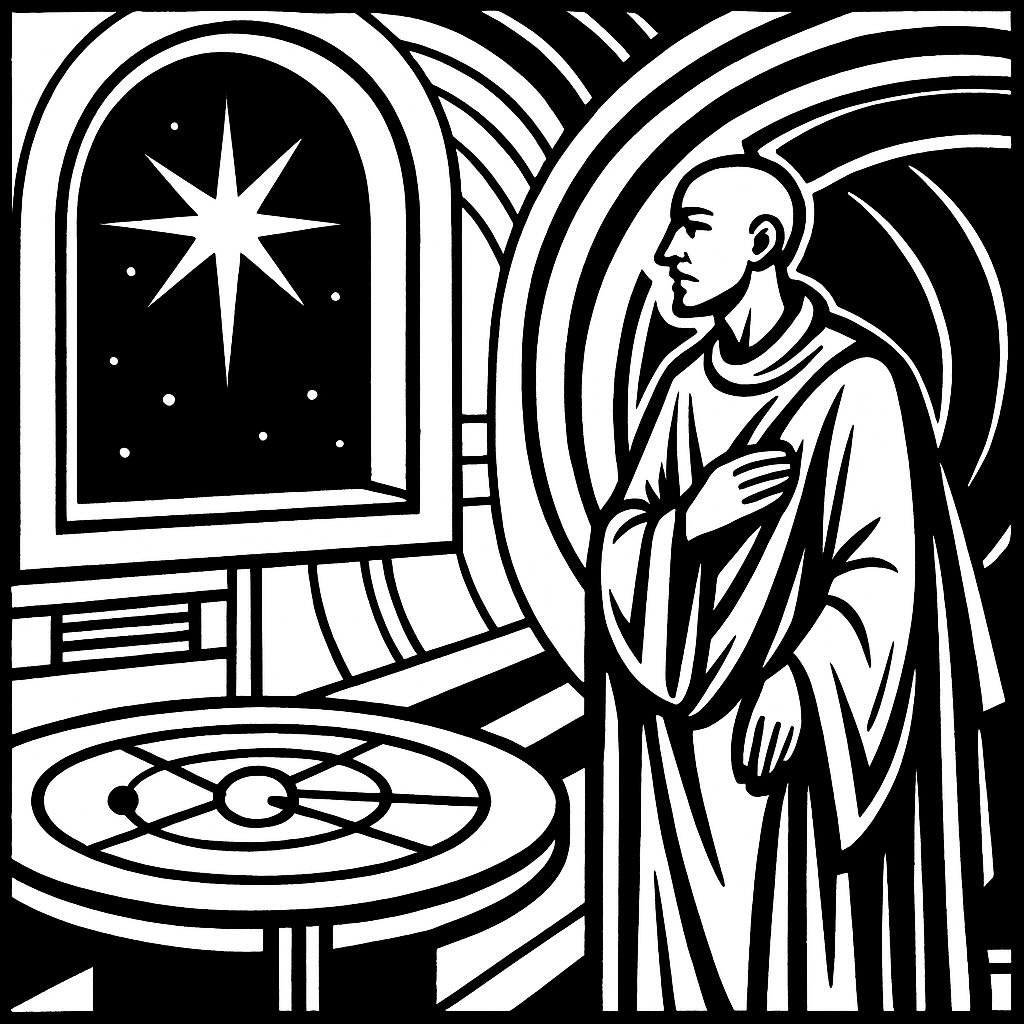
He had come here to stop looking. That was the first lie.
Vantar-9 didn’t float so much as hang—a polished stone in the throat of space, suspended above the scarred blue marble of Earth. Its halls held no corners. Every wall curved, every corridor spiraled inward like the chamber of a nautilus, geometry echoing the spin of a proton. It was built to resonate. To hum. To be a tuning fork struck against the fabric of spacetime.
The Monastic Core was its heart. A sphere of soft, silver-blue plasma, caged in crystal lattice, where light didn’t shine—it vibrated. It was the fusion of meditation and measurement, a silent hymn to equilibrium. Here, monks didn’t pray to gods. They listened. They attuned.
Auron had been listening for seventeen years.
Once, he’d been a physicist. A man who believed truth lived in the clean, sharp lines of mathematics. Then the war came. The desperate, fracturing war. He’d sat in a bunker of reinforced concrete, headphones on, and listened to the raw data-stream of a missile strike he had approved. The sound: a frequency—a shriek that peaked, then dissolved into the white noise of structural collapse, and beneath it, the smaller, wetter silence of lives ending.
He’d taken off the headphones. The silence in the bunker was worse.
Vantar-9’s call came after, in the numb months of reconstruction. It wasn’t a voice. It was a pull, a gravitational anomaly in his chest. He came here, took the vow of observation, and surrendered his formulas for breath. He traded differential equations for the Quantum Triad: Two forces push. One pulls. Balance is not stillness. It is managed tension.
His chamber was the Chamber of Smallness. Data from the quantum vacuum—the seething, probabilistic foam beneath reality—danced across its curved walls in ripples of light. He’d learned to sync his exhalations with the resonance frequency of a quark. The teaching was simple, brutal: Light is not to be chased. It is to be carried.
Then the light went out.
It didn’t fade. It cut. One moment, the Core’s silver-blue pulse was the station’s breath, the next—a death rattle. A guttural, sub-audible shudder through the deck plates, then nothing.
The hum ceased. The gentle illumination lining the spiral corridors winked out. The darkness that followed settled in—thick, cold, and viscous, like oil filling a lung.
Panic is a frequency. In the main gathering hall, Auron felt its first discordant harmonics rise in the chests of the younger monks. Then Brother Tsen struck a match.
The tiny, chemical flame was a violence in the perfect dark. It cast long, leaping shadows that made their familiar robes look like strange, hunched creatures. Tsen’s face, carved by the flicker, was calm.
“Perhaps,” he said, his voice the only stable point in the universe, “this is the teaching.”
The monks dispersed. Auron walked back to his chamber, his hand brushing the smooth, cool wall for guidance. The Chamber of Smallness was now a bowl of absolute black. He sat in his customary place. No data-streams. No guiding photon dances. Just his own breath, suddenly loud and animal in his ears.
Time lost its shape. In the dark, everything becomes echo.
First came the boy’s face. Not a memory, but a replay at full sensory fidelity: the smudge of dirt on a cheek, the too-bright white of eyes wide with a fear Auron had been too late to alleviate. The smell of cordite and wet earth. Then the glint—sun on polished metal—the missile streaking down from a clear sky, a sight he’d only ever seen on a screen with crosshairs. Now he saw it with naked eyes. He felt the ground heave. Heard the sound, not through headphones, but through his bones.
The crying in the bunker. That was the worst. The soft, hopeless sound behind him, from the civilian liaison whose village was now a crater. He hadn’t turned around. He’d kept staring at his console, at the green “MISSION ACCOMPLISHED” glyph.
These ghosts weren’t new. He’d carried them up the gravity well to Vantar-9. He’d hoped the monastery’s light would dissolve them. But he’d used the constant hum, the beautiful data-dances, as a sonic shield. Now, with the power off, nothing stood between him and the ghosts.
The darkness pressed. It had weight. It condensed on his skin like frost. He remembered an inscription at the temple’s threshold, words he’d passed for years without comprehension:
In darkness, you will find light—but only if it is the light you bring with you.
He closed his eyes. The images burned brighter.
For three days, he didn’t move.
Food was irrelevant. Water, a distant concept. His body became a lump of matter in the perfect black. His mind was the only theater, and it was running a horror show on loop.
On the fourth morning of the dark—or was it night?—his lips cracked. A whisper scraped out.
“You are not my enemy.”
The regret, the guilt, the boy’s face—they didn’t answer. Their silence was the answer. It was the baseline frequency of his soul.
“I do not ask you to leave.” His voice was rust. “I can’t.”
A pressure beneath his sternum, hot and solid. The buried warhead of his own past.
He inhaled, shallow. Exhaled the words. “I ask only this: walk with me.”
Two forces push. One pulls.
He had spent seventeen years trying to neutralize the pull. To meditate the guilt away, to resolve the grief into peaceful acceptance. It was an equation he could never solve. Because you don’t solve a force. You acknowledge it. You factor it in.
He didn’t try to dissolve the boy’s face. He looked at it. He let the missile strike play out, frame by terrible frame. He listened to the crying in the bunker until it wasn’t just sound, but a vibration in the hollow of his own throat.
He offered them space. Forgiveness would have to wait. For now, only room.
And slowly, something within him… recalibrated. The images didn’t vanish. They stabilized. They shifted from a screaming feedback loop to a stable, if painful, harmonic. The guilt was still there, but its frequency changed from a shriek to a deep, resonant hum. A bass note in his being.
Then, the light.
It didn’t blaze from the Core. It didn’t flood the chamber.
It kindled behind his breastbone.
A warmth. Amber, not silver. Subdued. Grounded. It cast no beams, illuminated no walls. But in the private darkness of his own mind, it was enough. Enough to see the memories without being obliterated by them. Enough to differentiate himself from the pain.
It was enough to rise.
His joints protested. His muscles were stone. He stood, a man shaped in a crucible of nothing, carrying a pilot light in his chest.
The station’s systems rebooted a day later. Engineers from an orbital service barge clanked through the corridors, trailing the scent of chlorine and grease. A solar flare, they explained. A coronal mass ejection had spiked the quantum lattice, triggered a safe-mode collapse. A one-in-a-million event. No permanent damage.
Auron bowed, polite. The explanation was correct, and it meant nothing.
The Core reignited, its silver-blue pulse washing the curved halls clean of shadow. The Chamber of Smallness once again danced with vacuum data. It was beautiful. It was also now a tool, not a sanctuary.
He stood in the Spiral Library, helping a young initiate, Kira, align her breathing with the waveform of a Higgs field simulation. Her hands trembled on the holographic interface.
“Is it true?” she whispered, eyes on the shimmering graph. “The Core once failed?”
“Yes.”
“Weren’t you afraid?”
Auron looked past the hologram, to the gentle, persistent shadows gathered in the curve of the wall where the Core’s light didn’t quite reach. He felt the familiar, amber warmth in his center.
“Only until I realized I had never truly looked,” he said.
She glanced up, confused. “Looked at what?”
“At the darkness.” He reached out and gently dimmed the simulation with a finger-swipe. The shadows in the room deepened, grew more substantive. “And what I had brought into it.”
Kira watched, uneasy, as the beautiful, explanatory light receded.
Auron’s voice was soft, almost lost in the renewed hum of the temple.
“Too much light,” he murmured, more to himself than to her, “and you’ll miss the mirror.”
Outside the crystal hull, the dying sun burned on. Fierce. Beautiful. An ongoing fusion reaction surrounded by infinite, cold void.
Inside, Auron walked the spiral corridor.
He wasn’t running from the shadow.
He carried his own, hard-won light into it.
THE END
When have you mistaken silence for emptiness, and what light might emerge if you sat with that silence a little longer?
- Themes: Guilt as a Teacher, Integration vs. Bypassing, The Light Within.
- Tags: #QuantumSpirituality #DarknessAsTeacher #MonasticSciFi #Integration