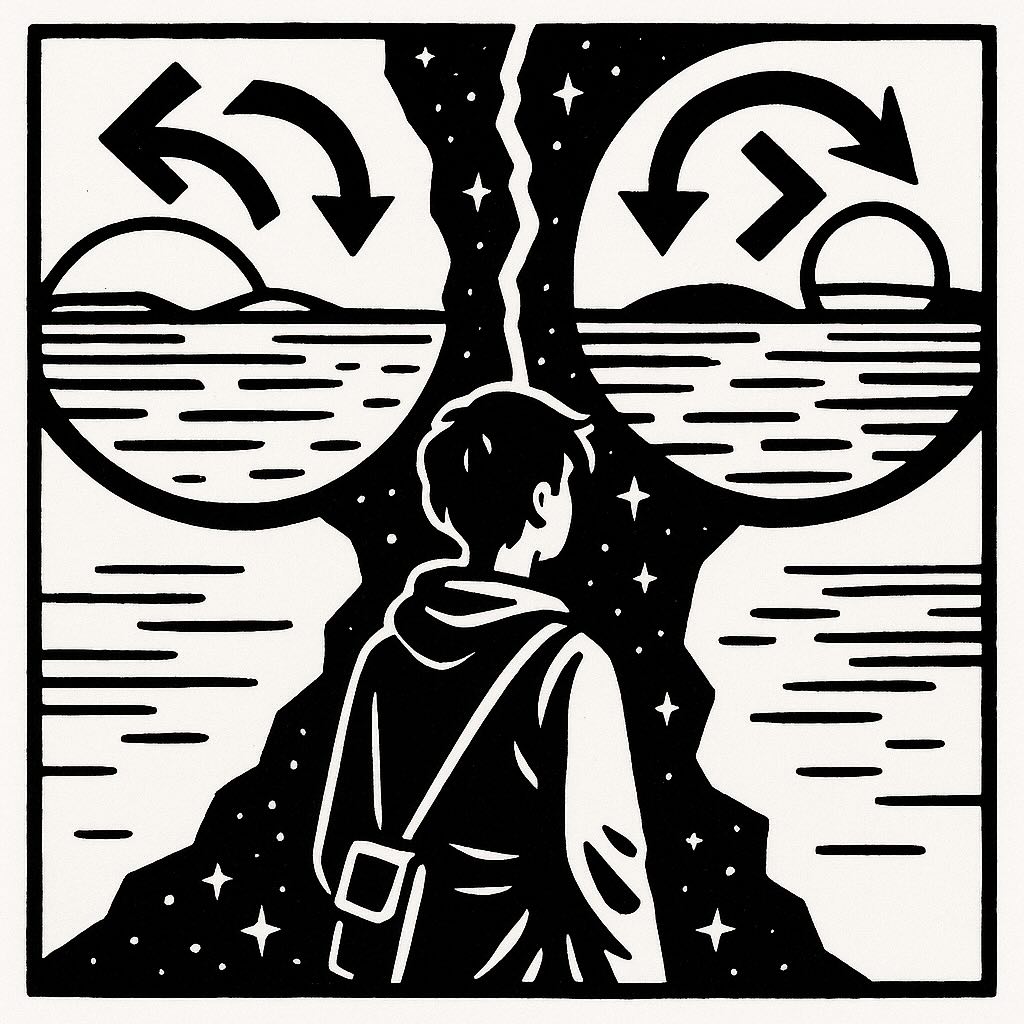
Koa’s eyes opened to dusk, the world washed in the color of a fading bruise. He had never seen a sunrise. In the Eastern Hemisphere of Virelia, light didn’t arrive—it retreated. Morning was the quietest part of the cycle, the sky bleeding out its last deep indigo before surrendering to the coming dark. He could feel it, a slow cooling against his skin, the way the air grew heavier as the day began.
He stood at the edge.
They called it the Inversion Wall, a shimmering curtain of liquid glass that hummed a low, perpetual B-flat. The sound wasn’t heard so much as felt—a vibration in the fillings of your teeth, a resonance in the hollow of your chest. From here, the colony behind him was a cluster of squat stone structures, their lamps already lit against the dimming noon. Ahead, the Wall pulsed. It didn’t reflect light so much as it swallowed and stretched it, turning the landscape on the other side into a wavering, impossible negative.
Everyone knew not to approach it. The warning wasn’t a law; it was woven into the grain of their lives, into the way their bodies remembered. Stepping too close could fray the edges of your own timeline. Koa’s fingertips tingled just looking at it.
The elders said time ran backward here. Clocks ticked counter-clockwise, their gears gnawing into the past instead of chewing toward the future. Children grew smaller, their faces smoothing from the wear of life back to the blank slate of birth. It was the natural order. The Continuance, in the West, called it perversion. Koa just called it home.
But he remembered things no child should.
The memories didn’t come with age. They came with un-age. As his body shed years, retreating toward a childhood he’d already lived, his mind sharpened. It didn’t fade; it focused. He remembered the war—carried as a scar: the acrid smell of charged particle rifles, the gut-shudder of collapsing buildings, the silence that followed a scream. He remembered trying to fix the world, over and over, by forcing the other side to see. He remembered the violence of good intentions.
It felt like shattered glass in his mind, each shard holding a different reflection of the same horror.
The Anomaly & The Echoes
In school, they had a word for him: precursive. His bio-field didn’t resonate cleanly with the backward flow of the East or the forward thrust of the West. He was a standing wave in the stream of time, an anomaly. The other children’s memories grew fuzzy as they un-aged, dissolving into potential. Koa’s calcified. They became anchors.
He could close his eyes and be there: the day the Truce was signed. He had been older then, his hands rough and scarred. He remembered the taste of metallic fear in the air, the hollow relief that wasn’t relief at all, just exhaustion. And he remembered, from before that, as a smaller child, watching the first missiles arc across the sky—their fiery trails seeming to suck light from the world rather than emit it.
The contradiction was a physical ache. A memory of an ending existing alongside the memory of its beginning. His skull felt too small to hold it all.
The elders of his colony chanted at the trans-cycle ceremonies, their voices a low drone meant to ground their reality in balance. They spoke of cycles of renewal. Koa heard only a desperate hum, a frequency meant to cancel out a fear they wouldn’t name. It no longer moved him. Something else did.
On the other side of the shimmering Wall, something pulsed. It wasn’t a sound or a light. It was a pull, a gravitational tug on the part of him that was unrooted. It felt like a truth that hadn’t happened yet. Or one that had happened so long ago its echo had finally made the round trip.
On the eve of his thirteenth un-birthday, the pull became a command.
He left the colony under the cover of the bright midday stars, his steps silent on the cold, resonant earth. The hum of the Wall grew from a vibration to a roar in his bones as he approached. His breath hitched. The air crackled with static, lifting the hair on his arms.
He reached out.
His fingers didn’t meet resistance. The liquid glass parted like a heavy curtain of ionized air, cool and electric against his skin. It felt like dipping his hand into a different density of reality. He took a step through.
And time… bent.
It wasn’t just reversed. Here, it was intentional. The wind against his face carried the ghost of a sound a second before the sound itself reached his ears—a whisper preceding the shout. People moved through the geometric streets of the Western settlement with a severe, polished precision. They didn’t walk; they executed trajectories. Every step was a decision already made, every glance a confirmed data point. Their bio-fields weren’t the soft, resonant hum of the East. They were tight, focused beams, lasers cutting a path through the future.
They were also afraid. He saw it in the micro-twitch of a jaw, the too-quick blink. Their fear had a different flavor. Their fear was contamination—of the blur—so different from the Eastern fear of dissolution, of coming undone.
“You.”
The voice was flat, devoid of echo. A woman in the gray, unadorned robes of the Order of Continuance stood before him. Her hair was shorn close, her eyes the color of polished slate. Her bio-field pressed against his, a wall of pure will.
“You come from the blur,” she stated. “The unrooted flow. The anomaly.”
Koa’s own voice surprised him. It sounded deeper here, weathered. “I come seeking understanding.”
Her lips pressed into a thin line. “Understanding is a byproduct of directed action. You cannot understand what you won’t fight to shape.”
The old anger, the war-anger, rose in his throat like bile. He let it pass. “I’m done fighting.”
She narrowed her eyes, and for a second, he saw not an enemy, but a believer clinging to a cliff’s edge. “Then you’ve already lost.”
He stayed. For three rotations of their relentless, forward-marching sun, he observed. He learned their logic, a beautiful and terrifying architecture built on the premise that control was the only path to peace. They had equations for empathy, flowcharts for morality. Their entire world was built on tension—the tension of holding the future in a vise-grip to keep it from shattering.
And it was brittle. He could feel it. In the way a soldier’s hand would tremble slightly before stilling, in the silence that fell between their perfectly planned words. Their certainty was a dam holding back a ocean of doubt.
On the third day, he stood before a convocation of their planners and asked the question that had been burning in him, the question their entire reality was designed to avoid:
“What happens if neither side wins?”
The silence that followed was absolute. It wasn’t thoughtful. It was horrified. It was the sound of a foundational frequency failing.
That night, he walked back to the place of the Wall. The air was thick with the scent of impending storm. But the storm wasn’t weather.
The Wall was no longer shimmering. It was roaring.
The Gathering Storm
From the Eastern side, his people emerged from the deepening twilight, their faces set in masks of protective fear. They carried resonant disruptors, weapons that didn’t pierce flesh but unraveled temporal coherence. Their chant was a familiar dirge of preservation.
From the Western side, under the harsh, artificial daylight lamps, the Order marched in lockstep. Their particle rifles glowed with a hungry blue light. Their silence was louder than any chant.
Both armies were drawn by the same thing: the terrifying symbol Koa had become. A bridge. A living question mark. Their entire histories, their sacrifices, their truths, were built on the axiom that the other perspective was a threat to be neutralized. He was the embodiment of neutrality, and it was the most threatening thing of all.
A forward-time officer raised a amplifier. “Anomaly! Step away from the divide. Your resonance is destabilizing the Truce boundary!”
An elder from the East, her voice amplified by a crystal resonator, cried out, “Koa! Return to the flow! Do not let them unmake you!”
The Wall between them throbbed, streaks of violent energy spider-webbing across its surface. It was going to rupture. The tension was too great. The war was about to begin again, not over land or ideology, but over the fear of a boy who refused to choose a side.
Koa looked at the armies, at the weapons, at the faces twisted by the same fundamental terror. He felt the old patterns rise—the urge to explain, to defend, to fight for the rightness of peace.
He let the urge go.
He didn’t step forward. He didn’t step back. He simply sat. Cross-legged on the resonant earth, at the exact point where the two time-flows met and warred. He was a child in body, an ancient in memory. He closed his eyes.
He didn’t pray. He didn’t chant. He breathed. In… and out. A rhythm older than hemispheres, older than war.
He remembered. Not just the pain, but the quiet moment before the first shot. The shared glance between two enemies who both missed the sun. The taste of a meal that had nothing to do with sides. He remembered the feeling of potential, the field of pure becoming that existed before fear collapsed it into action and reaction.
In the stillness, time trembled.
The roaring of the Wall didn’t cease—it changed pitch. The violent, cracking energy softened, diffused. The thrumming B-flat deepened, widened, becoming a chord. The Wall itself grew thin as it became irrelevant. It became a film, a veil, then a faint heat-shimmer in the air.
It disappeared. Not shattered.
Outgrown.
A forward-time soldier, his rifle half-lowered, took a hesitant step forward. His boot landed on what was once forbidden ground. He looked at an Easterner holding a disruptor. Neither moved.
Another step. From the East this time.
One by one, they crossed the line that was no longer there. They didn’t embrace. They didn’t speak. They just… stopped. They stood in the new space, their rigid bio-fields slowly, awkwardly, beginning to resonate with the unfamiliar frequency of the other.
Koa never moved. He was the silence at the center. A silence so full it became an invitation—deep listening, not emptiness.
The war ended that day—no treaty signed in triumph, no conquest of one truth over another.
With a choice. A collective, shuddering exhalation. A choice to stop propagating the fight.
The Whispering Field
Years later—or perhaps years earlier; the distinction began to feel quaint—the story was told. Elders, both Eastern and Western, spoke of the precursive boy who grew younger as he remembered the future. They spoke of how he didn’t fight the divide, but sat in its heart until the divide forgot what it was for.
Koa himself became myth. Then a memory. Then a silence woven into the land.
But at the place where the Wall once was, the air still hums. It’s a soft, complex resonance now, a field of blended frequencies. They call it the Whispering Field. In it, direction means less than intention. You can feel the past as potential and the future as memory, both existing in a permeable, vibrant now.
It doesn’t shout with revelation. It doesn’t shine with easy answers.
It whispers. And the whisper moves backward, against the grain of any single flow, waiting.
Always waiting for the next one willing to stop, to sit, and to grow into a truth larger than their side of the war.
THE END
What are you still holding onto in order to win, that might dissolve if you simply chose to witness?
- Themes: Non-Duality, Time Perception, The Power of Witnessing.
- Tags: #TimeWar #NonDuality #TheWitness #PeaceThroughPresence