
Weight came first. Not gravity—gravity had been artificial for weeks—but mass. The feeling of substance returning to what had become vapor. Nils Aerten felt it settle into his bones the moment the light-cuffs dissolved: a heaviness in the wrists, a drag in the shoulders, as if his body remembered what his mind refused to carry.
The escort drones hummed a frequency labeled reassurance. It vibrated in his skull. Compliance ensures calibration, they whispered in tidy sonic pulses. He didn’t believe a word. Belief had been cauterized out of him somewhere between Andromeda’s radiation tides and this dead-side Venus orbit.
Station ILEX hung in permanent shadow, a cold jewel against the black. No bars. No guards. Just mirrors.
They called it a Refractive Cognitive Rehabilitation Environment. He called it what it was: A prison.
The first room was an octagon of perfect, punishing clarity.
Nils woke to his own face—forty-two versions of it, staring back from every angle. Weathered. Sharp. Unblinking. Behind the eyes, though, something flickered. Memory’s echo—trapped in the glass like smoke—flickered behind his eyes, nothing he could claim as his own.
At first, it was noise. A spilled drink, dark liquid spreading across a table. A voice—his voice—snapping a word that cut. A hand trembling. Someone else’s, not his.
The system didn’t accuse. It reflected. And it used their eyes to do it.
He’d been told he hurt people. A classified case, sealed for psychological integrity. He remembered none of it. Only fragments. Echoes without source.
He spent the first days pacing, fists clenched, gaze fixed on the seamless floor. But the mirrors were everywhere. And they were patient.
On the third day, the reflections sharpened.
A girl’s face, half-turned, resigned rather than afraid. A door slamming—too hard, too final. A data apprentice flinching as Nils tore his calculations apart—too slow, not mistaken. His own voice, layered over time: sarcastic, dismissive, then cold. Then cruel.
They were small things. Betrayals so minor they’d felt like breathing. But they had frequency. They had rhythm. And together, they built architecture.
On the sixth day, he wept. Disbelief, not guilt, finally broke him.
Is this me?
The air shifted. A low hum resonated through the floor—a sympathetic vibration. The wall in front of him shimmered, thinned, became permeable. He’d earned a progression.
Each new room was a mirror of the last, but the angles grew sharper. The light more direct. Now the reflections showed not what he did, but why.
His father’s silence—a field of negative space Nils had spent a lifetime trying to fill with noise. His mother’s disappearing smile—fading each time his brilliance outshone her kindness. Teachers who praised his intellect and overlooked his arrogance, because productivity was easier to measure than empathy.
He saw the thread. It wasn’t random. It was circuitous. Deliberate. He had learned to hurt so he wouldn’t be weak. He had mocked so he wouldn’t be seen. He had isolated himself in intellect because the heart conducted too much current—and he was afraid of the burn.
Knowing wasn’t owning. Knowing was just another map of a territory he still refused to enter.
Room Nine held a table. On it, two tablets glowed with soft, persistent light.
One read: Those I Harmed. The other: Those Who Harmed Me.
The interface accepted only manual input. No voice. No thought-transfer. Just finger on surface, tracing letters into light.
He worked for days. Names came slowly. Then moments. Then the resonances between them. He didn’t write to confess. He wrote to see. To find the pattern in the noise.
When he finished, both lists shimmered—and a third tablet manifested between them.
Who I Am Becoming.
No prompts. No guidelines. Just empty space and the hum of possibility.
That night, the mirrors responded not with memory, but with light. A soft glow from every surface. Not white. Not gold. Just… warm.
For the first time in years, Nils slept without dreaming.
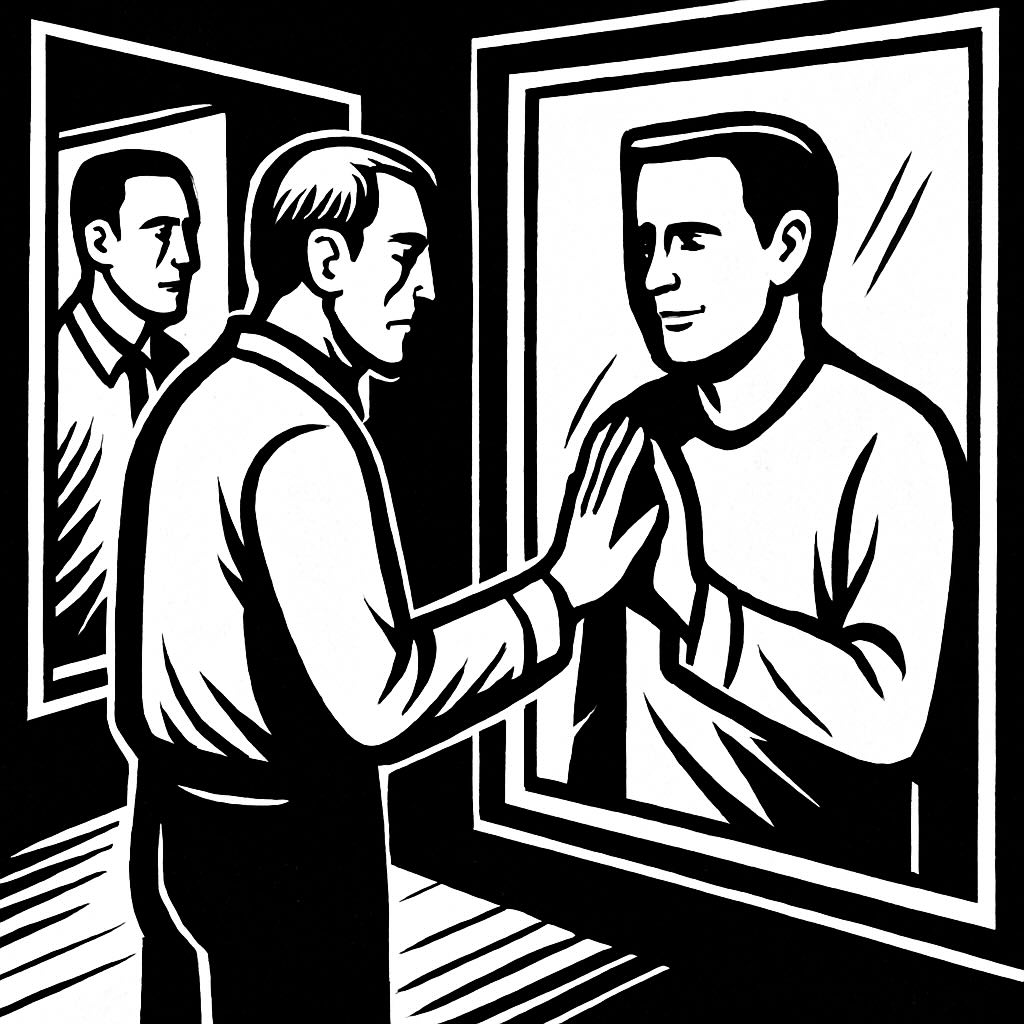
The next morning, the walls didn’t open. He sat in the stillness. Watched his breath fog the glass—once, twice, a rhythm. And then, without sound, a new image formed.
A version of himself he didn’t recognize—clearer, neither younger nor older. The eyes were softer. The scars of knowing were still there, but they looked less like wounds and more like topography.
This self spoke no words. It only reached out a hand.
Nils reached back.
The glass rippled. The figure dissolved.
Behind it, a window opened onto real space. Real stars. No filters. No projections. Venus hung below, shrouded in permanent twilight. Above, the Milky Way curved like a spine of light.
No announcement came. No drone escort. Just the gentle shift of the floor beneath him—a slight, sustained thrust.
He had not been released. That word was too small.
He had been refocused.
Back on Earth, in a prison library tinged with dust and old paper, a boy stared through a barred window. Dawn bled light across the sky. Somewhere above, a pinpoint of silver moved slowly—a station, or a ship, or a star refusing to fade.
The boy didn’t know its name. But he felt, in some frequency deeper than thought, that someone up there had made it through.
And for a moment, the air in the library felt less like a sentence, and more like a signal—waiting to be received.
THE END
What part of yourself have you kept hidden because it was easier not to look?
- Themes: Radical Self-Inquiry, Shadow Work, The Trap of Denial.
- Tags: #ShadowWork #PrisonOfSelf #Reflections #InternalAlchemy