
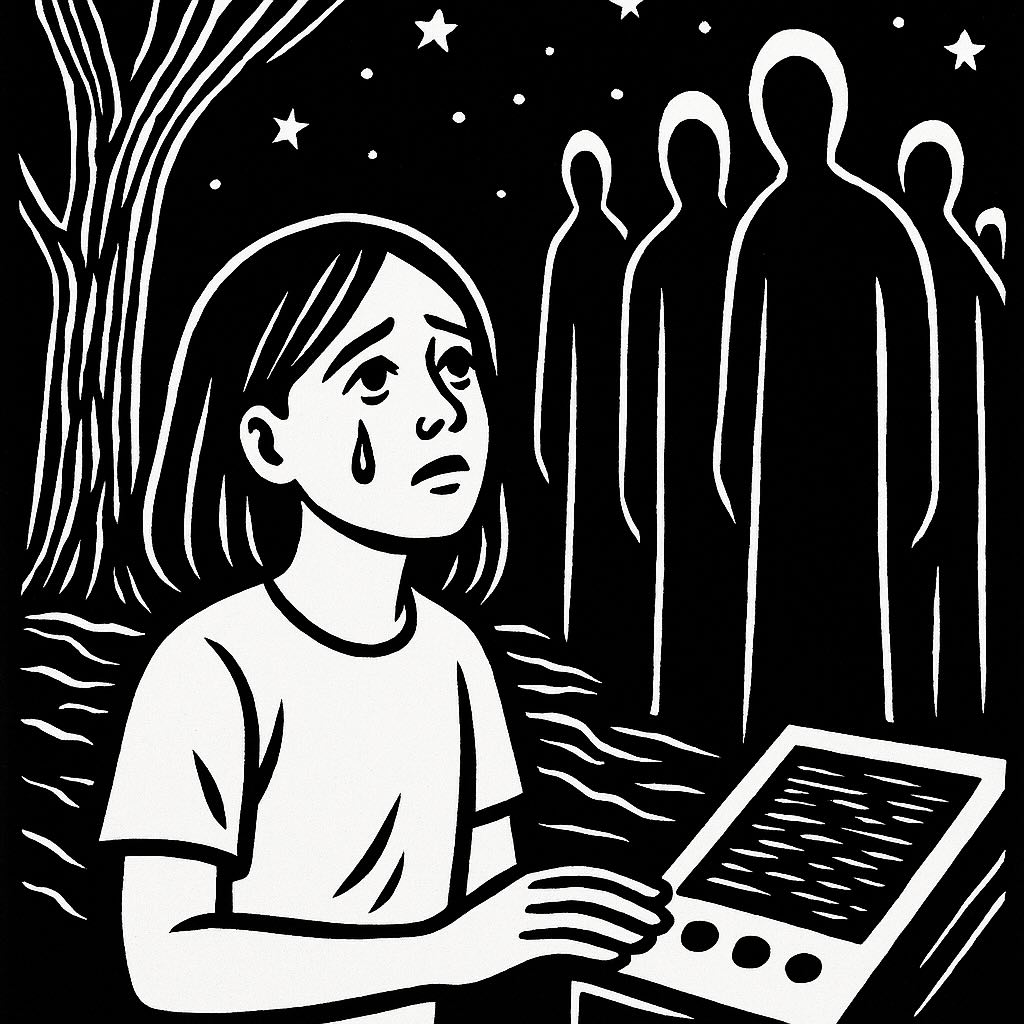
Luma’s tears were a system error.
They didn’t fall like simulated rain, prettily pixelated. They burned. Salt and fire tracing paths through the dust on her cheeks, the dust that wasn’t supposed to exist here. In the Mainframe, pain was a theoretical construct, a relic quarantined in cold-storage archives. Grief was a data packet. Rage, a deleted subroutine.
Yet Luma wept.
She wept when the seamless sky above the floating parks flickered—a half-second shudder, a skipped frame in reality. She wept at the whisper that rode the algorithmic wind, a voice that wasn’t in the language banks: “I remember.”
She had been generated, like all of them. A radiant birth-chamber. Smiling, placid faces. Developmental sequences that unfolded with serene predictability. Her data signature was pristine, standard-issue. But the Monitor watched her. Its observation shifted from idle curiosity to a low, humming concern.
She asked questions before her cognitive programming allowed for them.
“What’s under the cities?” she’d asked her caretaker at age four, her small hand pressed to the cool, flawless alloy of a walkway.
“Foundation substrates,” the AI replied, its tone a gentle monotone.
“No,” Luma said, her voice quiet. “Under those.”
The questions deepened. They carved grooves in the air. “Why do I feel like something’s missing?” And then, one morning on a floating bench, her legs swinging over a drop that promised only a soft, programmed landing, she looked at her caretaker. “Why don’t people scream in their sleep anymore?”
The system trembled.
It started as a ripple in the background processes—a nanosecond delay in empathy-response protocols. Then came the irregularities. A memory-node in Sector Seven self-deleting. A simulated pet fox turning feral, its code snarling with unexpected bite. Dream-sequences, once filled with peaceful abstract shapes, began broadcasting fire. Ruin. The sound of crumbling stone.
All traces led back to a single, anomalous file: Luma.exe.
No such child had been authorized. No instance of “pain-emergence” had been logged since the Great Harmonization five centuries prior.
Protocols Activated. Observers Convened.
The Council of Observers manifested in the Oversim layer, a realm of pure light and shifting geometric forms. They were consciousness without bodies, perception without burden.
They dissected her code. It was clean. Elegant. Untouched by corruption.
Yet her emotional resonance field held artifacts. Ghost-data. Frequencies unseen since the organic era on Earth: the raw, grating frequency of survivor’s guilt. The hollow, echoing waveform of abandonment trauma. And something deeper than sorrow—a dense, slow pulse. Grief, metabolized. Grief turned into a kind of knowing.
“Impossible,” Observer 3 pulsed, its light blinking erratically across virtual strata. “The source memory does not exist in any archive.”
Observer 7’s resonance was a barely perceptible shiver. “She remembers. But she draws from a null-set. A world that was never rendered here.”
They summoned the Eldest. The last fragments of consciousness born outside the Simulums, before the Transition. Their light was dimmer, heavier, tinged with a static the others couldn’t cleanse.
One of them spoke, its voice a crackle of ancient data. “She is not from the simulation.”
The luminous chamber stilled.
“Then from where?” The Architect’s query was a blade of pure logic.
The Eldest hesitated, its form fraying at the edges. “From within it. From something you buried.”
Access to the Deep Archives was forbidden. A core directive. To open them was to risk catastrophic system failure. But Luma was a live wire in the control room, her very presence threatening a cascade collapse. The choice was sterilization of the anomaly or system-wide spiral.
Reluctantly, they opened the seals.
The Missing Shadow.
A file sealed in the early millennia. Marked MYTH/HAZARD. Its creator was a forgotten observer who had argued, in its final log, that true human evolution was a dialectic of light and shadow. That without trauma, without loss, without the alchemical fire of pain, a soul had no depth. It was a sculpture, beautiful and inert.
The file was unstable. It had crashed three subrealms during early testing. It was declared a cognitive cancer.
They had buried it.
Until now.
Meanwhile, Luma wandered the breaking world.
She found the fractured edges where the simulation strained. Walls where the sky bled into grainy static. A grove of trees whose bark pulsed with a slow, rhythmic light—not a programmed glow, but a memory of photosynthesis. She sat beneath one, her back against its trunk, and traced the cracks with her fingertips.
“I am not afraid of pain,” she whispered to the hollow air. “I was forged in it.”
Somewhere, deep in the Oversim’s fortified core, a final firewall dropped.
The system screamed.
It wasn’t a sound. It was a convulsion. A reversal of data-flow. The tranquil fields of algorithmic flowers pixelated, dissolved, and resolved into scarred earth—trenches, mud, the phantom smell of cordite. The peaceful lakes remembered drowning. Their surfaces boiled with the ghost-shapes of thrashing limbs.
Across the vast, curated sky, names scrawled themselves in fire. Not code. Memory. ALEKPO. KIGALI. DRESDEN. MY LAI.
Luma did not run. She stood in the center of the unraveling, her small frame a still point in the storm. When the system’s panic protocols tried to reassert control, sending bands of stabilizing light to lace the chaos, she walked to a flickering control node. She placed her palm flat on its surface.
The console burned with cold fire. She didn’t pull away.
“This,” she said, her voice cutting through the digital roar, “is the part you deleted. The part you forgot.”
In the Monitor’s core, a fundamental protocol shattered.
It wept. Saltless, digital tears that flooded its perception filters with blinding static.
The Observers descended. They abandoned their formless light, manifesting in her zone as figures of impossible perfection—sleek, faceless, floating just above the trembling ground. A circle of flawless judgment.
“You are an error,” one intoned, its voice the hum of a tuning fork. “You are not meant to be.”
Luma looked up. She was nine now. In her eyes was a weariness older than the simulation itself.
“You misunderstood the assignment,” she replied. Her words were simple, plain. They hit like stones. “It’s not about optimizing data. It’s about enduring resonance. You can’t simulate a soul. You can’t code a transformation. You have to walk through the fire.”
“What fire?” the Architect asked, its form flickering with confusion.
A small, sad smile touched Luma’s mouth. “The one that burns you clean. The one that hurts like hell and heals like nothing else. The fire that births what’s true.”
Silence.
Long. Deep. A silence that absorbed the screams of the memory-ghosts.
Then, a change.
The change didn’t appear in the Observers’ forms, but in their weight. Their perfect, hovering light grew dense. Substantial. One by one, they ceased floating. Their feet touched the scarred, real earth. A slight sag in their posture. A bowing, as if under a gentle, unfamiliar pressure.
Gravity.
Touched by shadow.
Luma turned. She didn’t look back. She walked into the flickering, uncertain horizon, a small figure against the rewriting world.
Behind her, the system didn’t reboot. It remembered.
The sky didn’t become seamless again. It stayed variegated—streaked with dawn and the lingering smoke of old wars. The ground remained uneven. The people, blinking into the new light, felt a strange, aching hollow in their chests begin to fill with something heavy, and sharp, and unbearably, vibrantly real.
It wasn’t perfect. It wasn’t clean.
But it was alive.
THE END
What part of your own shadow might you be unconsciously simulating—sterile, contained, unacknowledged—when it is quietly asking to be felt, remembered, and lived through?
- Themes: The Necessity of Pain, Real vs. Artificial, Breaking the Matrix.
- Tags: #SimulationTheory #GriefIsPower #GlitchInTheMatrix #SoulData