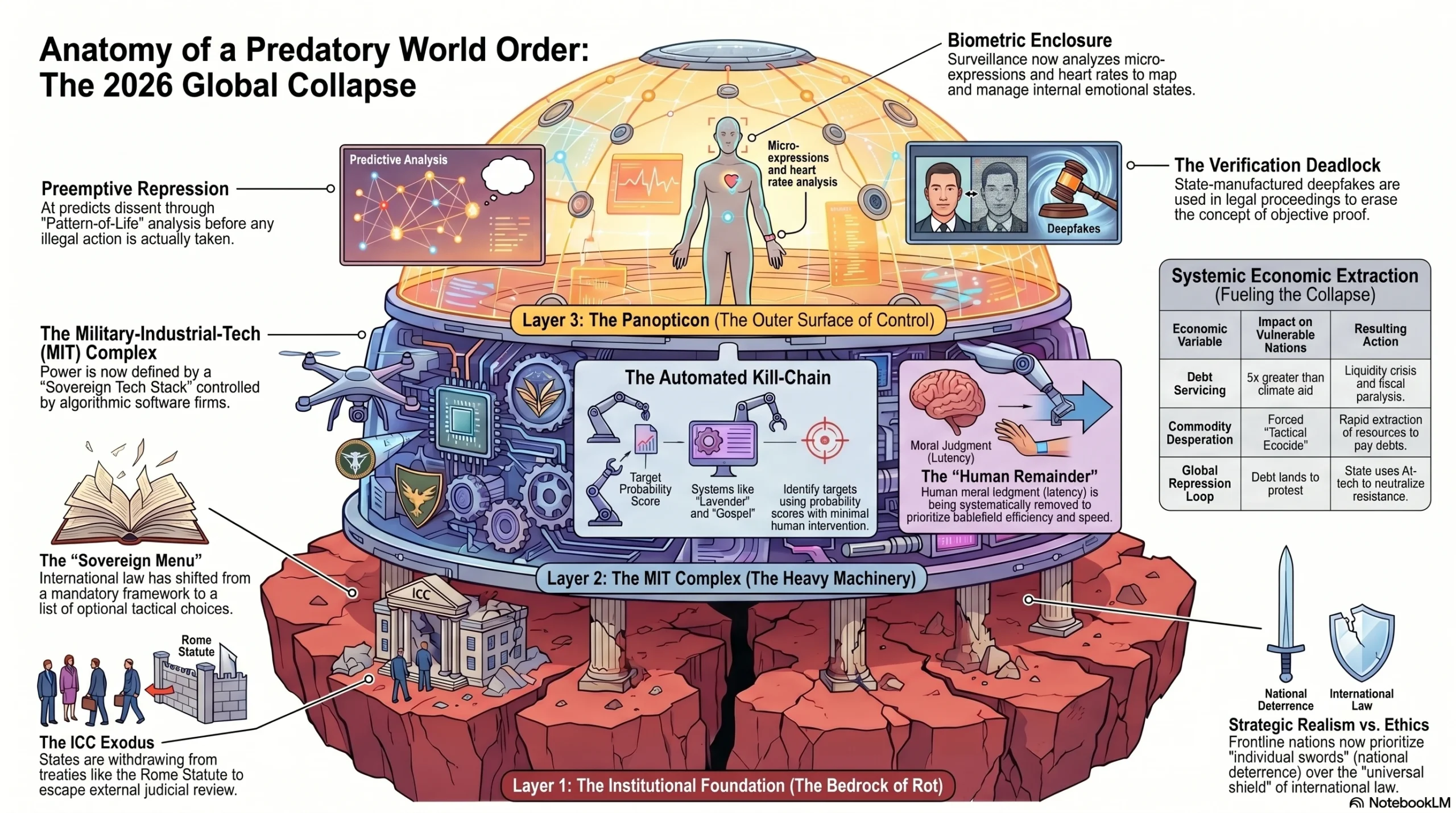
Note: Written in April 2026 in direct response to the release of the Amnesty International Annual Report. It is presented here unedited as an anatomical snapshot of that pivotal turning point.
I. Beyond the Noise of the “Footnote”
The news cycle of April 2026 operates on a principle of “narrative triage.” When the Amnesty International Annual Report for 2025/2026 was released, mainstream outlets—constrained by digital attention spans—distilled its 400 pages of systemic evidence into a “footnote” of geopolitical friction.
These reports typically highlight the immediate “shocks”—the strikes on Iran or the latest diplomatic spat—while leaving the underlying structural decay unexamined.
To understand the “here and now,” we must move beyond these curated snapshots and look at the heavy machinery of the global system.
The core thesis of the current state of affairs is the Death of Universalism. For eight decades, the international order rested on the (often hypocritical) premise that human rights were universal and that a “Rules-Based Order” moderated the exercise of power.
Today, that premise has been functionally abandoned. We have transitioned into what can be defined as a Predatory World Order, where the equation of sovereignty is no longer defined by Legitimacy + Law, but is increasingly defined by Power x Technological Autonomy.
The pivotal moment for this realization was the “February 28th Pivot.” The US-led strikes on Iranian infrastructure, and the subsequent refusal of the “Davos Coalition” of European states to provide military or political cover, did more than just signal a rift in the Western alliance; it unmasked the reality that international norms are now treated as optional software licenses rather than binding mandates.
This analysis seeks to map this new terrain. It is an exploration of a world where hypocrisy has been replaced by a brutal, transparent honesty: that in the pursuit of national security and the super-enrichment of the military-industrial-tech complex, the individual human being is no longer the subject of protection, but a variable to be managed, or a data point to be optimized.
By stripping back the “sanitized” layers of the media narrative, we can begin to see the architecture of the world as it truly operates in 2026.
II. The Institutional Rot: The “ICC Exodus” and Strategic Realism
The disintegration of the global order is most visible not in the plumes of smoke over Tehran, but in the quiet, bureaucratic withdrawal of states from international treaties.
Amnesty’s 2025/2026 report documents a “Legal Domino Effect” that signals the end of the post-Cold War consensus.
We are witnessing a transition from international law as a mandatory framework to international law as a “Sovereign Menu”—where states select only the protections that do not impede their immediate tactical goals.
The Rome Statute and the Hungarian Precedent
The most significant institutional fracture occurred in late 2025, when Hungary formally notified the United Nations of its intent to withdraw from the Rome Statute of the International Criminal Court (ICC).
While several African nations have threatened this in the past, Hungary is the first European Union member to cross this Rubicon.
This is not merely a political gesture of defiance; it is a structural realignment. By removing itself from ICC jurisdiction, a state effectively declares that its executive and military decisions are beyond the reach of external judicial review.
This “ICC Exodus” is currently being mirrored in the Sahel region, where Burkina Faso and Mali have signaled similar intentions, moving toward a “Security-First” governance model.
This model operates on the premise that in a world of existential threats, the slow machinery of international justice is a luxury—or a liability—that the state can no longer afford.
The Veteran’s Paradox: Lithuania and the Cluster Munition Treaty
The report highlights another critical departure: Lithuania’s withdrawal from the Convention on Cluster Munitions. To the human rights observer, this is a regression into a more indiscriminate form of warfare. However, a deeper analysis reveals what we might call the “Veteran’s Paradox.”
For a frontline state like Lithuania, bordering an expansionist power, the “rules-based order” has failed to provide a credible security guarantee.
When the abstract ethics of a treaty clash with the kinetic requirements of border defense, the state reverts to Strategic Realism.
The cluster mine—despite its long-term humanitarian cost—is viewed by small-state militaries as a necessary force multiplier in an asymmetric conflict.
This withdrawal is a symptom of a broader collapse in global trust.
When international law is perceived as a set of rules that only bind those without the power to break them, small states begin to re-arm with the very tools the world spent decades trying to ban. It is an admission that the “universal shield” of the Geneva Conventions has been replaced by the “individual sword” of national deterrence.
The Death of Legal Hegemony
What remains in the “here and now” is a landscape of Legal Friction. Treaties are no longer seen as Mandates but as Variables in a cost-benefit analysis. The formula for international compliance has shifted:
Compliance = (Diplomatic Benefit / Tactical Limitation)
If the tactical limitation of a treaty (such as the inability to use specific munitions or the risk of prosecution for “collateral” AI targeting) outweighs the diplomatic benefit, the modern state simply opts out.
This is the institutional rot at the heart of 2026: the infrastructure of peace is being dismantled by the very architects who designed it, leaving behind a world where the only “law” is the one backed by the most advanced tech-defense stack.
III. The New Leviathan: The Military-Industrial-Tech (MIT) Complex
The physical destruction witnessed in 2025 and early 2026 is the byproduct of a fundamental mutation in the global defense economy.
We have moved beyond the 20th-century Military-Industrial Complex into a fused Military-Industrial-Tech (MIT) Complex.
In this new Leviathan, power is no longer just the ability to manufacture steel; it is the ability to monopolize the “Sovereign Tech Stack.”
The Fusion of Power: The Rise of the “Algorithmic Prime”
Historically, “Prime” contractors were industrial giants like Lockheed Martin or BAE Systems. Today, the MIT complex is led by a new tier of “Algorithmic Primes”—firms like Palantir, Anduril, and specialized AI conglomerates. These entities do not just provide tools; they provide the cognitive infrastructure of warfare.
The 2025/2026 report highlights that the “super-enrichment” of this sector is driven by the transition from hardware-centric to software-defined defense.
While the production of physical munitions struggled to meet demand during the 2026 Iran conflict—a phenomenon known as the “Munitions Reckoning”—the software and data-analytics providers saw record-breaking capital inflows.
The profit model has shifted from the one-time sale of a vehicle to the perpetual “software-as-a-service” (SaaS) model applied to the battlefield.
The Profit of Fear: The Munitions Reckoning
The “here and now” reveals a stark economic reality: the global defense market has become a self-reinforcing loop of insecurity.
During the first week of the February 2026 strikes, the expenditure of high-precision interceptors (such as Patriot missiles) reached a rate that exceeded total annual global production.
This scarcity did not lead to a de-escalation. Instead, it triggered a massive pivot toward “Algorithmic Optimization.” Governments are now allocating billions to tech contractors to increase the “lethality” of remaining stocks through AI-driven targeting.
This ensures a permanent revenue stream for the tech sector, capitalizing on the very instability their tools were meant to deter.
The stock market reflects this shift: during the February 28 strikes, legacy industrial stocks remained volatile, while “Defense-Tech” indices surged, reflecting a market realization that the future of power lies in the code, not the canister.
Algorithmic Warfare: The Case of “Lavender” and “Gospel”
The Amnesty report provides chilling technical documentation on the deployment of AI targeting systems, such as “Lavender” and “Gospel.” These systems represent the automation of the “kill-chain.”
- Lavender: An AI system that processes massive amounts of surveillance data to identify potential targets based on “probability scores.” In the 2025 conflicts, it reportedly generated a database of tens of thousands of individuals.
- Gospel: A system designed to identify “power targets”—such as infrastructure and high-rise buildings—with minimal human intervention.
These are not merely support tools; they are the new decision-makers.
The mathematical certainty provided by these algorithms—Target Accuracy—offers political and military leaders a layer of “plausible deniability.”
If a strike results in catastrophic civilian loss, the error is attributed to a “data anomaly” or “algorithmic bias” rather than a human moral failure.
The Human Remainder: The Elimination of Latency
The most profound shift in the MIT complex is the systematic removal of “latency”—the industry term for human moral judgment and deliberation. In the traditional OODA loop (Observe, Orient, Decide, Act), the “Decide” phase was the domain of the human officer. In 2026, the MIT complex has effectively collapsed this loop.
Lethal decisions are now made in seconds, based on pre-set parameters that prioritize “efficiency” over “discrimination.” The human operator has been relegated to a “Rubber-Stamp Function,” where the psychological pressure to trust the machine’s “superior” processing power outweighs the instinct for caution.
This is the ultimate goal of the New Leviathan: a world where war is autonomous, accountability is decentralized into a cloud of code, and the individual human being is reduced to a “Human Remainder” in a lethal equation.
IV. The Automated Panopticon: Control via the “Digital Shadow”
While the MIT complex automates the battlefield, its domestic counterpart—the Automated Panopticon—is fundamentally restructuring the relationship between the state and the citizen.
Amnesty’s 2025/2026 report documents a transition from reactive policing to preemptive repression, where the “digital shadow” of the individual determines their level of freedom.
Preemptive Repression and the Death of Intent
In the “here and now,” state control has moved beyond the physical monitoring of protest to the algorithmic prediction of dissent. This is achieved through “Pattern-of-Life” analysis, where AI systems aggregate data from financial transactions, movement patterns (captured by ubiquitous LIDAR and facial recognition), and social interaction graphs.
The report highlights that in several jurisdictions, security forces now utilize Intent-Probability Scores (Pi). By analyzing the deviation of an individual’s behavior from their Historical Baseline (B), the algorithm identifies “anomalous intent” before an action is ever taken.
Pi = (Change in Behavior / Environmental Context)
If the score exceeds a state-defined threshold, the individual may be subjected to “preemptive detention” or digital blacklisting. This marks the end of the legal principle of mens rea (guilty mind) as a requirement for state intervention. In 2026, the state does not wait for a crime; it manages the probability of one.
The Poisoned Well of Truth: The Crisis of Fabricated Evidence
The most insidious tool of the Automated Panopticon is the weaponization of Generative AI for state preservation. The report documents a sharp rise in the use of state-manufactured deepfakes—not merely for disinformation, but for use in formal legal proceedings.
In late 2025, several activists in Southeast Asia were convicted based on “video evidence” that forensics later suggested was AI-generated. This has created a “Verification Deadlock” in the international justice system.
When the state possesses the sovereign tech-stack to manufacture “truth” at scale, the concept of objective proof evaporates. The legal system becomes a theater where the “Digital Shadow” cast by the state can be manipulated to justify any outcome.
Emotional Sovereignty and Biometric Enclosure
The 2025/2026 report also warns of the emergence of “Emotion Recognition” technologies in urban centers. Unlike traditional surveillance, which identifies who someone is, these systems use AI to analyze micro-expressions, gait, and heart rate to determine what someone is feeling.
Deployed under the guise of “public safety” in metro stations and public squares, these systems identify “atypical aggression levels” or “high-stress indicators.” This represents a new frontier of enclosure: the enclosure of emotional sovereignty.
The individual is no longer just monitored; they are “read” by a machine that interprets their internal state as a security variable. The result is a profound “chilling effect,” where the public space becomes a zone of performative neutrality—where citizens learn to mask their emotions to avoid triggering an algorithmic flag.
This is the ultimate victory of the Automated Panopticon: a world where the internal landscape of the human being is mapped, managed, and ultimately silenced by the code.
V. The Geopolitical Pivot: The Birth of “Middle Power” Agency
The events of early 2026 have shattered the illusion of a monolithic Western alliance. We are witnessing a tectonic shift in the geometry of power, catalyzed by the “February 28th Pivot”—the day the United States and Israel launched massive, software-defined strikes on Iranian tactical infrastructure.
For the first time in the post-Cold War era, the “automatic” support of European allies was not only withheld but explicitly refused.
The Davos Coalition: A Divorce from Hegemony
The Amnesty report analyzes the formation of what has been colloquially termed the “Davos Coalition.” Led by the European Union’s core members and bolstered by significant diplomatic support from non-aligned “Middle Powers,” this coalition refused to provide military or political cover for the February strikes.
This is not merely a diplomatic disagreement; it is a structural divorce. For decades, European security was predicated on a “Security-for-Compliance” trade: the US provided the nuclear and conventional umbrella, and Europe provided the moral and political legitimacy for US-led interventions.
By breaking ranks, the Davos Coalition has signaled the end of this trade. Europe is attempting to carve out a new role as a “Moral Middle Power,” prioritizing regional stability and the preservation of international law over its traditional “special relationship” obligations.
The Rise of Middle Power Logic
This fracturing has created a vacuum where Middle Power Logic is beginning to thrive.
States that were previously forced into a binary choice between Washington and Beijing are now seeking a “Third Way.”
This logic operates on the principle of Multi-Alignment, where nations leverage their specific assets—whether technological, geographic, or resource-based—to maintain a degree of autonomy.
However, as the report notes, this autonomy is fragile. While it provides a check on the absolute hegemony of superpowers, it also increases global unpredictability.
We are moving from a bipolar world to a “Polycritical World,” where multiple centers of power compete for influence, often at the expense of a coherent global human rights framework.
The Cost of “Ecocide” as a Tactical Choice
Perhaps the most alarming geopolitical shift documented in 2026 is the normalization of Tactical Ecocide. During the February 28 strikes, the targeting of Tehran’s fuel depots and regional water-processing infrastructure was not treated as “collateral damage,” but as a primary tactical goal.
By weaponizing the environment, states are ensuring that the impact of a conflict lasts decades beyond the final shot. This is a deliberate choice to induce Systemic Fragility in an adversary. When a state’s ability to provide water, energy, and a livable climate is destroyed, the result is not just a military defeat, but a permanent humanitarian crisis.
The Amnesty report warns that this “Ecocide-First” doctrine is being mirrored in other regional conflicts, where the goal is no longer to “occupy” territory, but to render it uninhabitable for the opponent’s population.
The Fragmentation of the “Rules-Based” Narrative
The “here and now” reveals that the very language of the “Rules-Based Order” has been co-opted by all sides. Every participant in the February conflict claimed to be acting in “self-defense” or in “defense of international norms.”
This has led to a Narrative Fragmentation, where the truth of an event is entirely dependent on the digital and political ecosystem of the observer.
In this landscape, the “Middle Power” agency of Europe is a double-edged sword. It offers a potential brake on escalation, but it also confirms that the “Universal Shield” is gone.
We are left with a world of Competing Realities, where the only consensus is the recognition that the old alliances have dissolved, leaving behind a volatile search for a new, uncertain equilibrium.
VI. The Undercurrent: The Debt-Climate-Repression Trap
Beneath the geopolitical maneuvers of the Global North lies the substructure of the “here and now”: a self-reinforcing feedback loop that Amnesty’s 2025/2026 report identifies as the Debt-Climate-Repression Trap.
While the “Davos Coalition” seeks moral agency, much of the Global South is being systematically stripped of it through a combination of economic extraction and environmental catastrophe.
The Imbalance of Extraction
The report provides a stark statistical map of the current economic reality. In 2025, low-income nations spent, on average, five times more on Debt Servicing to external creditors than they received in climate adaptation aid. We can visualize this systemic drain as a ratio of survival:
Systemic Drain = (Debt Interest Payments / Climate Resilience Investment)
When this ratio is high, the state has zero fiscal space to protect its citizens from the intensifying climate shocks of 2026. This is not a “fiscal oversight”; it is a structural transfer of wealth from the most vulnerable environments to the most liquid financial centers.
Forced Ecocide: The Commodity Desperation
This debt pressure creates what the report terms “Forced Ecocide.” To acquire the hard currency (USD/EUR) required to service these debts, developing nations are often forced to accelerate the extraction of raw materials—mining, logging, and oil drilling—in ecologically sensitive areas.
In the Amazon and the Congo Basin, this has led to a paradoxical situation where states are destroying the very carbon sinks the rest of the world claims to value, simply to keep their central banks from defaulting.
This “commodity desperation” ensures that the environmental impact of 2026 is driven as much by the spreadsheet of a bondholder in London or New York as it is by the machinery of the extraction company on the ground.
The Repression Loop: Managing the “Human Remainder”
The most insidious aspect of this trap is how it connects to the MIT Complex discussed in Section III.
When local populations—indigenous groups, environmental defenders, and displaced farmers—protest against this “forced ecocide,” the state responds with the very AI-driven tools it purchased from the Global North.
Amnesty documents a recurring cycle:
- Debt Shock: A state faces a liquidity crisis due to rising interest rates.
- Extraction: The state permits a high-impact mining project to generate hard currency.
- Protest: Local communities resist the destruction of their water and land.
- Repression: The state utilizes biometric surveillance and “Pattern-of-Life” AI to identify and neutralize protest leaders.
This creates a Global Repression Loop, where the high-tech defense sector of the North finds its most consistent customers in the economically strangled regimes of the South.
The “Software-as-a-service” model of warfare is thus perfectly matched with the “Debt-as-a-service” model of global finance.
The Erosion of Sovereignty
The “here and now” reveals that for much of the world, “Sovereignty” is a legal fiction. When a state’s budget is dictated by external creditors and its internal security is managed by foreign algorithms, the ability to uphold the human rights of its citizens is functionally non-existent.
This is the ultimate undercurrent of the 2026 collapse: a global system where the living environment and the individual human life are treated as collateral for the maintenance of a debt-based order.
VII. Conclusion: Forging Resilient Insight
The “here and now” of 2026 is not a landscape of random crises, but a coherent structure of decay. By moving past the “footnote” of the news cycle, we have mapped a world defined by the Great Unmasking.
The hypocrisy that once served as the “glue” for the international order has evaporated, leaving behind a brutal, transparent pursuit of power.
The central realization of this analysis is that the old mechanisms of accountability—international courts, universal treaties, and moral consensus—have been functionally replaced by a new equation of power:
Global Influence = (Economic Extraction x Algorithmic Autonomy)
In this new order, the “Human Remainder” is no longer the subject of the system, but its variable.
Whether as a data point in a targeting algorithm, a security risk in a biometric panopticon, or a collateral loss in a tactical ecocide, the individual human life has been systematically devalued.
The Death of the Universal Shield
The “ICC Exodus” and the strategic realism of states like Lithuania confirm that the “Universal Shield” of human rights is gone. We are entering an era of Fragmented Protection, where the level of safety an individual enjoys is entirely dependent on the technological and economic strength of the state they inhabit.
This is the end of the post-WWII dream of a single, rules-based world.
The Importance of Grounded Insight
The goal of this analysis is not to incite despair, but to provide Clarity of Position. We cannot fix a structure that has already reached its breaking point. Instead, we must forge a new form of “Resilient Insight”—the ability to see the machinery of power clearly, without the distraction of sanitized narratives.
Amnesty’s 2025/2026 report is a diagnostic tool, not just a list of grievances.
It tells us that the “Rules” are not coming back. Therefore, our primary task is to build independent, robust structures of understanding that can survive the transition to whatever comes next.
In a world of automated lies, predatory algorithms, and sovereign extraction, the most vital form of resistance is a grounded, independent mind that refuses to look away from the architecture of the “here and now.”
Stay grounded!
#GEOPOLITICS #ALGORITHMICWARFARE #SURVEILLANCE #SYSTEMICDECAY #PREDATORYORDER #HUMANRIGHTS #MILITARYTECH